


 English

News
Wed 08 , 2026
When people ask “what is a manifold on a car?”, they are usually referring to an important engine component that controls the flow of air or exhaust gases. In modern vehicles, manifolds play a critical role in improving engine efficiency, performance, and emissions control.
Among different types of manifolds, the intake manifold is one of the most important components because it distributes air evenly to the engine cylinders for combustion.
With the development of lightweight automotive Designs, many manufacturers are replacing traditional metal components with advanced plastic solutions. This has increased the demand for plastic intake manifold manufacturing and precision automotive injection molds.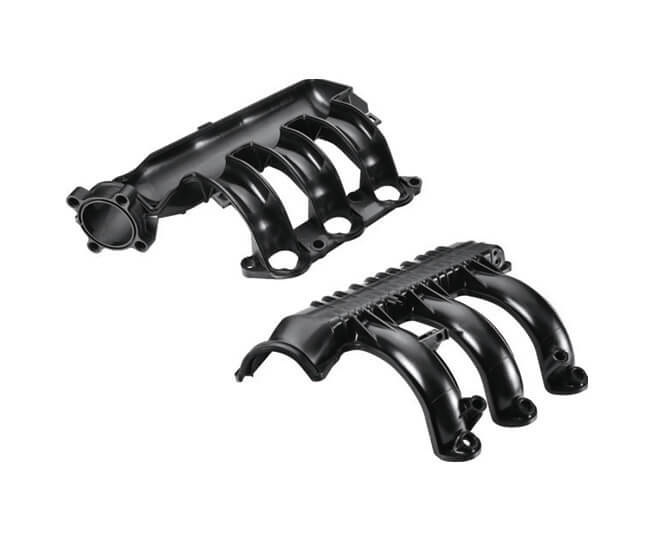
A manifold is a component designed to collect and distribute fluids or gases within a vehicle system. In automotive applications, manifolds mainly manage the movement of air and exhaust gases.
The two most common types are:
Intake manifold
Exhaust manifold
Although they have different functions, both are essential for efficient engine operation.
The intake manifold controls the supply of air entering the engine, while the exhaust manifold collects exhaust gases from the cylinders and directs them into the exhaust system.
An intake manifold is an engine component that distributes the air-fuel mixture or air from the throttle body to each cylinder.
Its main functions include:
The engine requires a precise amount of air for combustion. The intake manifold ensures that each cylinder receives a balanced airflow, helping maintain stable engine performance.
A well-designed intake manifold can optimize airflow speed and reduce turbulence, improving fuel efficiency and engine response.
Modern vehicles often use lightweight plastic intake manifolds because they provide advantages in weight reduction, design flexibility, and cost control.
Traditional intake manifolds were commonly made from aluminum or other metals. However, advanced engineering plastics have become increasingly popular in automotive manufacturing.
A plastic intake manifold offers several benefits:
Reducing vehicle weight is an important goal for automotive manufacturers. Plastic components are significantly lighter than metal alternatives, helping improve fuel economy.
Injection molding allows manufacturers to create complex internal structures, optimized airflow channels, and integrated features that are difficult to produce with traditional machining methods.
High-volume production through injection molding reduces manufacturing costs while maintaining consistent quality.
Unlike metal components, engineering plastics are not affected by rust and provide excellent durability in automotive environments.
The production of an intake manifold requires precise engineering and advanced manufacturing technology. For high-volume automotive applications, intake manifold injection molding is widely used.
The general manufacturing process includes several steps:
Engineers first create a 3D model based on airflow requirements, engine specifications, and installation conditions.
A professional automotive mold manufacturer then develops the injection mold according to the product design.
Important factors include:
Mold structure
Cooling system design
Material selection
Injection pressure control
Dimensional accuracy
During injection molding, melted plastic material is injected into a precision mold cavity under high pressure.
After cooling and solidification, the molded intake manifold is removed from the mold.
This process ensures:
High production efficiency
Stable dimensions
Repeatable quality
Reduced material waste
Automotive components require strict quality control. Manufacturers inspect:
Product dimensions
Surface quality
Strength performance
Airflow performance
Assembly accuracy
Different engineering plastics can be selected depending on performance requirements.
Common materials include:
PA materials provide excellent mechanical strength, heat resistance, and durability, making them widely used in automotive components.
Adding glass fiber improves stiffness and dimensional stability, making it suitable for demanding engine environments.
Special high-performance plastics may also be selected according to temperature resistance, chemical resistance, and application requirements.
The quality of an intake manifold largely depends on the precision of the injection mold.
A reliable intake manifold mold manufacturer needs strong capabilities in:
Mold design
CNC machining
Precision manufacturing
Mold testing
Production optimization
Automotive molds must achieve excellent dimensional accuracy because even small deviations can affect airflow performance and engine efficiency.
Advanced mold manufacturing helps automotive suppliers produce reliable plastic components with consistent quality.
As vehicles continue moving toward lightweight and efficient designs, the demand for automotive plastic parts continues to grow.
Besides intake manifolds, injection molding is widely used for:
Engine covers
Air ducts
Interior components
Electrical housings
Automotive structural plastic parts
Youking specializes in precision mold manufacturing solutions, including automotive molds, plastic injection molds, and customized Tooling for complex automotive components.
With professional mold design, advanced machining capabilities, and strict quality control, Youking helps customers develop high-quality plastic automotive parts for different applications.
So, what is a manifold on a car? A manifold is a key component responsible for managing airflow or exhaust gas movement inside a vehicle system. Among them, the intake manifold plays an essential role in delivering air efficiently to the engine.
With the advantages of lightweight design, flexible structures, and efficient mass production, plastic intake manifolds have become an important trend in automotive manufacturing.
For companies looking for reliable intake manifold injection molding solutions or an experienced automotive mold manufacturer, choosing the right tooling partner is essential for achieving better product quality and production efficiency.
We attach great importance to the customers' demands for product quality and rapid production.
We always believe that meeting the customers' needs is the realization of our value!