


 English

News
Thu 08 , 2026
Plastic injection molding has become a critical manufacturing process for modern automotive components. From engine compartments and air management systems to electrical housings and interior trim, injection-molded plastics can provide a combination of low weight, dimensional stability, Design flexibility, corrosion resistance, and high-volume production efficiency.
The choice of material and molding process depends heavily on the component's operating environment. A part located near an engine may require high-temperature engineering plastics, while an interior trim component may prioritize surface appearance, impact resistance, and dimensional accuracy.
This article examines 10 common automotive parts made with plastic injection molding, while explaining how different materials and molding technologies are selected for specific automotive applications.
For a broader introduction to automotive manifolds and their manufacturing process, see What Is a Manifold on a Car? Understanding Intake Manifolds and Their Manufacturing Process.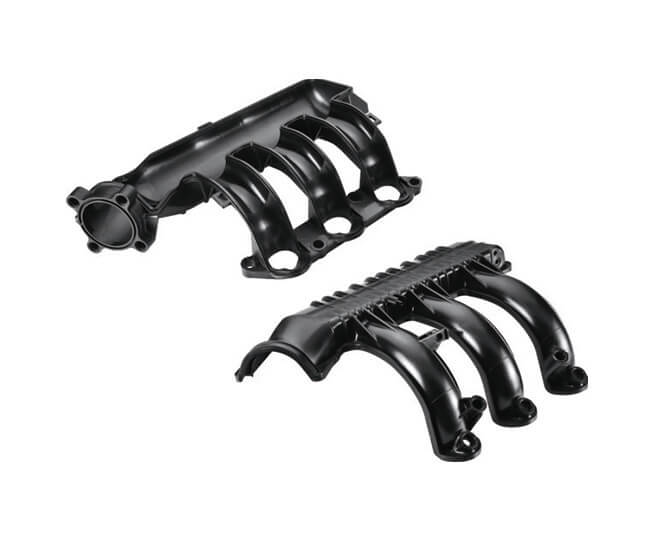
Intake manifolds are one of the most technically demanding automotive components that can be produced with plastic injection molding.
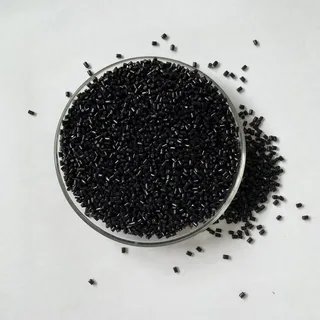
Modern intake manifolds are frequently manufactured from engineering thermoplastics such as glass-fiber-reinforced nylon, which can provide a useful balance of temperature resistance, mechanical strength, chemical resistance, and weight reduction.
Compared with conventional metal construction, an injection-molded plastic manifold can integrate complex internal passages and external mounting structures into a single component.
Typical requirements include:
High-temperature resistance
Dimensional stability
Resistance to engine fluids
Complex internal geometry
Low warpage
High weld-line strength
The mold must accurately reproduce internal runners, ports, mounting bosses, ribs, and other features. Depending on the geometry, slides, lifters, and carefully designed cooling channels may be required.
This is a good example of how automotive injection molding combines material engineering with precision mold design.
Engine covers are another common application for injection-molded plastics.
Depending on the required thermal performance and appearance, manufacturers may use materials such as PA, PP, ABS, or glass-fiber-reinforced engineering plastics.
The material selection depends on whether the component is primarily decorative or exposed to elevated temperatures and mechanical loading.
Injection molding makes it possible to integrate:
Mounting points
Clips
Ribs
Logo areas
Cable-routing features
Reinforcement structures
For visible engine components, surface finish and dimensional consistency are also important.
A well-designed mold can reduce secondary operations by incorporating these features directly into the molded component.
Air ducts and intake tubes often need to balance rigidity with lightweight construction.
Common materials include PP, PA, and other engineering thermoplastics, depending on temperature, pressure, and chemical requirements.
For air management components, engineers may pay particular attention to:
Internal surface geometry
Airflow path
Wall thickness
Dimensional stability
Connection interfaces
Vibration resistance
The injection molding process is well suited to producing complex duct geometries at scale.
When the component includes undercuts, integrated connectors, or complex mounting structures, the mold architecture becomes a major part of the engineering solution.
Plastic fluid reservoirs are widely used in modern vehicles for applications such as coolant, brake fluid, windshield washer fluid, and other automotive systems.
Depending on the application, materials may include PP, HDPE, and specialized engineering plastics.
For example, polyethylene molding is commonly associated with applications where chemical resistance, toughness, and low moisture absorption are important considerations.
The design of these components must account for:
Chemical compatibility
Temperature fluctuations
Wall thickness
Weld lines
Dimensional stability
Long-term sealing performance
Although polyethylene processing is well established, the final performance depends on the exact resin grade, mold design, process parameters, and application environment.
Modern vehicles contain a large number of electronic modules, sensors, connectors, and control units. Many of these systems require precision injection-molded housings.
Materials such as PC, ABS, PC/ABS, PA, and PBT may be selected depending on requirements for electrical insulation, impact resistance, thermal stability, and dimensional accuracy.
Electronic housings may incorporate:
Connector interfaces
Snap fits
Screw bosses
Sealing features
Mounting brackets
Cable channels
Small dimensional errors can affect assembly performance, so mold precision and process control are critical.
In applications where electronics are integrated into visible interior components, film insert molding may also be considered.
Automotive interiors are one of the largest application areas for injection-molded plastic components.
Examples include:
Instrument panel components
Door trim
Center console parts
Pillar trim
Air vents
Switch bezels
Decorative panels
Materials can include PP, ABS, PC/ABS, and TPO, depending on the application.
Interior components often require a combination of:
Appearance + tactile quality + dimensional accuracy + impact resistance + UV resistance
Surface requirements may include grain textures, gloss control, decorative patterns, or soft-touch finishes.
Film insert molding can be used when manufacturers want decorative graphics, textures, or functional patterns to become an integrated part of the molded component.
Instead of applying a separate decorative layer after molding, a printed film can be positioned inside the mold before resin injection. The polymer then bonds with the film during the molding cycle.
Potential applications include:
Dashboard trim
Control panels
Decorative interior panels
Switch interfaces
Automotive electronic surfaces
This process can reduce certain secondary decoration steps while providing greater integration between appearance and structural components.
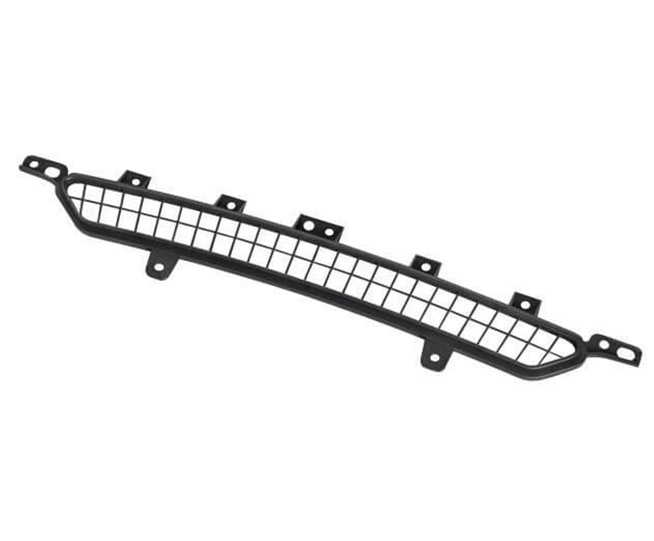
Automotive grilles, exterior trim pieces, mirror components, and other body-related plastic parts are frequently manufactured using injection molding.
Typical materials include:
ABS
PP
ASA
PC/ABS
Reinforced engineering plastics
Exterior parts have to withstand environmental exposure, temperature cycles, vibration, and impact.
For visible exterior components, manufacturers also need to control:
Surface defects
Sink marks
Weld lines
Warpage
Dimensional variation
Gloss consistency
This places strong requirements on both mold design and process optimization.
A properly engineered gating system and cooling layout can have a direct effect on part quality.
Sensors are becoming increasingly important in modern vehicles, including systems for temperature, pressure, position, parking assistance, and driver-assistance functions.
Many sensor housings and protective components are manufactured from precision injection-molded plastics.
Materials may include PBT, PA, PC, and other engineering thermoplastics selected for their mechanical and thermal properties.
These components typically have relatively small dimensions but tight tolerances.
Important considerations include:
Connector alignment
Sealing interfaces
Wall thickness
Shrinkage
Dimensional stability
Assembly tolerances
For these applications, the quality of the injection molding Tools is particularly important because small tooling errors can become significant at the assembly level.
The growth of hybrid and electric vehicles has significantly increased demand for precision plastic components used in battery and electrical systems.
Injection-molded components may include:
Electrical housings
Connector bodies
Cable-management components
Protective covers
Insulating structures
Module components
Material selection becomes particularly important because components may need to provide:
Electrical insulation
Flame resistance
Thermal stability
Dimensional stability
Mechanical strength
Chemical resistance
In some applications, reinforced polymers or specialized engineering plastics are preferred over conventional commodity plastics.
Mold design may also require tight control of warpage because even minor dimensional deviations can affect electrical interfaces and sealing systems.
Not all automotive injection-molded parts are large or visually obvious. A large number of small clips, brackets, retainers, guides, and fastening components are also produced using injection molding.
These components may use materials such as:
PP
PA
POM
PBT
Glass-fiber-reinforced polymers
The correct material depends on the required combination of flexibility, wear resistance, stiffness, and temperature performance.
For example, a snap-fit component may require controlled elasticity, while a structural bracket may require greater stiffness and creep resistance.
These small components also demonstrate why injection mold design must account for material shrinkage, draft angles, parting lines, ejection, and cycle time.
Different automotive applications require different material systems. Selecting a resin only according to price can lead to premature failure or poor dimensional performance.
PP is widely used because it offers:
Low density
Good chemical resistance
Good fatigue performance
Relatively low material cost
Good processability
Common applications include interior trim, ducts, housings, brackets, and fluid-system components.
Nylon is often selected when higher mechanical strength and temperature resistance are required.
Glass-fiber-reinforced PA can further improve:
Stiffness
Dimensional stability
Heat resistance
Structural performance
This makes reinforced nylon suitable for demanding components such as intake manifolds and engine-compartment parts.
ABS offers a useful combination of impact resistance, appearance, and processability.
It is frequently used for:
Interior trim
Housings
Bezels
Decorative components
PC/ABS blends combine characteristics of polycarbonate and ABS and are commonly used where both impact performance and appearance are important.
Typical applications include instrument-panel components, electronic housings, and interior trim.
PBT provides good electrical insulation, dimensional stability, chemical resistance, and temperature performance.
It is particularly useful for electrical and electronic automotive components.
Polyethylene can be useful for applications requiring toughness, chemical resistance, and moisture resistance.
Depending on the specific resin grade, polyethylene molding can be considered for selected reservoirs, containers, ducts, and other automotive components.
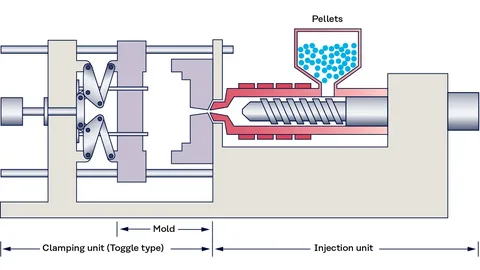
A plastic molding machine is only one part of the automotive manufacturing system. Consistent production depends on the interaction between the machine, mold, material, process parameters, and quality-control system.
Important machine-related parameters can include:
Injection pressure
Injection speed
Holding pressure
Barrel temperature
Screw speed
Cooling time
Clamping force
For complex automotive parts, the processing window must be carefully established to minimize defects such as warpage, short shots, sink marks, flash, and dimensional variation.
The mold itself is equally important.
High-quality injection molding tools need to be designed according to the material, part geometry, expected production volume, and dimensional requirements.
Important tooling considerations include:
Cavity and core design
Gate location
Runner configuration
Cooling channels
Venting
Ejection system
Slides and lifters
Mold steel selection
Surface finish
For automotive applications, mold flow analysis can also help engineers identify potential filling, cooling, weld-line, and warpage issues before mold fabrication.
In the broader injection molding process, the feed throat is part of the material feeding system that connects the hopper area with the screw and barrel.
The term feed throat injection molding is generally associated with considerations around polymer feeding, material flow, and machine design rather than being a specific automotive part category.
Stable feeding is important because inconsistent material supply can affect melt preparation and ultimately part quality.
For automotive molding projects, material drying requirements, resin handling, feeding stability, and barrel conditions should all be considered together with mold and machine parameters.
Automotive plastic components are rarely defined by material selection alone.
A successful automotive injection molding project normally requires coordination between:
Part Design → Material Selection → Mold Design → Simulation → Tool Manufacturing → Machine Setup → Injection Process → Inspection
A change in one stage can affect the others.
For example, increasing glass-fiber content may improve stiffness but also alter shrinkage and anisotropy. A change in wall thickness can affect filling and cooling. A new gate location can influence weld lines and surface appearance.
This is why automotive injection projects often require a much more systematic engineering approach than simple plastic part production.
The automotive industry uses plastic injection molding for a broad range of components, from intake manifolds and engine covers to electronic housings, interior trim, fluid reservoirs, battery components, and precision clips.
The most suitable material depends on the operating environment and performance requirements. PP, PA, ABS, PC/ABS, PBT, PE, and reinforced engineering plastics can each serve different applications.
At the same time, the quality of the final component depends on much more than the resin. Mold geometry, cooling, gating, machine parameters, process control, and inspection all contribute to the final result.
For manufacturers developing new automotive plastic components, selecting the right automotive injection molding process and a properly engineered mold at the beginning of the project can improve dimensional consistency, production efficiency, and long-term product reliability.
For more background on automotive manifold construction and manufacturing, read What Is a Manifold on a Car? Understanding Intake Manifolds and Their Manufacturing Process.
We attach great importance to the customers' demands for product quality and rapid production.
We always believe that meeting the customers' needs is the realization of our value!