


 English

News
Thu 08 , 2026
Plastic injection overmolding is a specialized injection molding process used to combine two or more materials into a single integrated component. In a typical application, a rigid plastic substrate is produced first, followed by injection of a second material over selected areas of the substrate. The two materials can provide different mechanical, functional, or aesthetic properties within the same part.
Unlike conventional single-material injection molding, overmolding requires engineers to consider not only cavity filling and cooling, but also material compatibility, interfacial bonding, substrate geometry, thermal behavior, shrinkage, and mold Design.
This makes overmolding particularly useful for automotive components, electronic housings, medical devices, hand Tools, handles, seals, and products that require both structural rigidity and a soft or functional surface.
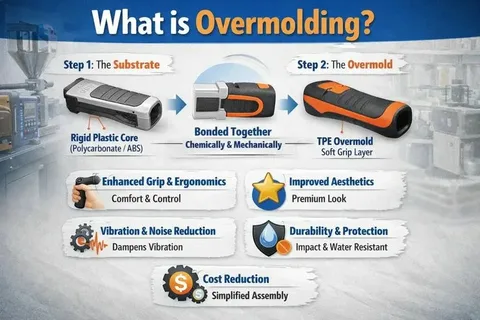
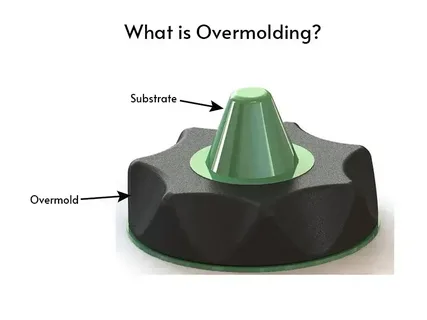
In simple terms, overmolding means molding one material over an existing molded component.
A typical combination may consist of:
A rigid PP, ABS, PC/ABS, PA, or other engineering-plastic substrate
A TPE, TPU, TPV, or other elastomeric overmold material
The first material provides structural strength, dimensional stability, or mechanical support, while the second material can provide grip, cushioning, sealing, vibration absorption, insulation, or improved surface appearance.
For example, a rigid plastic component can be covered with a softer TPE layer to create a non-slip grip. In another application, an elastomer can be overmolded onto a rigid housing to form an integrated sealing interface.
The key engineering challenge is achieving a reliable interface between the substrate and overmold material. Bonding can involve chemical interaction, mechanical interlocking, molecular entanglement, or a combination of mechanisms. Material temperature, viscosity, surface condition, and texture can all influence the result.
The main reason for using overmolding is to combine different material properties in one component.
Instead of manufacturing two separate parts and assembling them afterward, overmolding can integrate them during the molding process.
Typical objectives include:
TPE or TPU can be molded over a rigid plastic core to create a softer, higher-friction surface.
Elastomeric materials can provide cushioning and vibration-damping characteristics.
A soft material can be molded around a housing or interface to create an integral sealing feature.
A secondary material can help protect sensitive areas from moisture, dust, impact, or handling.
Different colors, textures, and surface finishes can be integrated into the same component without relying entirely on secondary assembly operations.
Overmolding can therefore reduce assembly complexity while allowing engineers to assign different functions to different materials.
The exact process depends on the part design, materials, production volume, and selected tooling configuration. In general, the overmolding process follows several engineering stages.
The first component, or substrate, must be designed specifically for overmolding.
Engineers need to consider:
Wall thickness
Draft angles
Shrinkage
Undercuts
Mechanical interlocks
Bonding surfaces
Mold positioning
Gate locations
A conventional injection-molded part is not automatically suitable for overmolding. The substrate needs enough dimensional stability and structural integrity to withstand the second molding stage.
Material selection is one of the most important steps.
The substrate and overmold resin need to work together from both a chemical and thermal perspective. Some material combinations can form relatively strong bonds, while others require mechanical locking features because chemical adhesion is insufficient.
Engineers may evaluate:
Melt temperature
Processing temperature
Mold temperature
Thermal expansion
Shrinkage
Hardness
Flexural modulus
Chemical compatibility
Surface energy
Required service temperature
For soft-touch applications, TPE and TPU are commonly considered, while rigid substrates may include PP, ABS, PC/ABS, PA, and other engineering plastics.
The substrate is injection molded first.
Depending on the production method, the substrate can then remain within a specialized multi-stage mold or be transferred into another mold for the second shot.
Two widely used approaches are:
Two-shot molding: the substrate and overmold are produced within a coordinated multi-shot tooling system.
Pick-and-place overmolding: the first molded component is transferred into another cavity before the second material is injected.
The substrate must be accurately located before the second injection stage.
This is particularly important when the overmold only covers selected areas.
Tooling may use:
Locating features
Cavity nests
Pins
Mechanical stops
Robotic handling
Dedicated fixtures
Poor positioning can produce inconsistent overmold thickness, flash, incomplete coverage, or dimensional problems.
The second resin is injected into the mold around the selected areas of the substrate.
At this stage, the injection parameters must be carefully controlled.
Important variables include:
Melt temperature
Injection speed
Injection pressure
Packing pressure
Mold temperature
Cooling time
Clamp force
The overmold material must flow correctly without displacing the substrate or creating excessive stress at the material interface.
As the second material fills the cavity, it must establish a stable interface with the substrate.
Depending on the material combination, bonding may result from chemical adhesion, mechanical interlocking, molecular interaction, or several mechanisms acting together.
After filling and packing, the component is cooled until the overmold reaches sufficient rigidity for ejection.
The finished component is then ejected and inspected.
Typical quality checks may include:
Bond strength
Surface appearance
Overmold position
Flash
Warpage
Dimensional accuracy
Shore hardness
Functional fit
Leak or sealing performance
For production parts, inspection criteria should be established during the tooling and process-development stages rather than after mass production begins.
Material selection is application-specific, but several combinations are widely considered.
Thermoplastic elastomers are commonly selected when a flexible, soft-touch, or high-friction surface is required.
Typical applications include:
Handles
Grips
Seals
Protective surfaces
Consumer product housings
TPU can provide a useful combination of flexibility, abrasion resistance, toughness, and surface performance.
It can be used for protective or flexible overmolded areas where greater mechanical durability is required.
This combination can be useful when a rigid PP substrate needs a softer or more tactile surface.
These combinations are often considered for housings, controls, handles, and consumer or automotive components where appearance and tactile characteristics are important.
However, a material pair should never be selected simply because it is commonly used. Resin grades, additives, surface treatments, processing temperatures, and actual application conditions can significantly affect bonding.
Overmolding vs insert molding is a common engineering comparison because both processes integrate multiple materials into a single component.
The fundamental distinction is the nature of the first component.
In overmolding, the second material is molded over a preformed substrate, which is often an existing plastic component.
Example:
Rigid plastic substrate + TPE outer layer
The objective may be to add grip, cushioning, sealing, protection, or another functional characteristic.
In insert molding, a preformed component—commonly a metal insert—is placed directly into the mold before plastic is injected around it. The insert becomes embedded within the final plastic component.
Examples include:
Threaded metal inserts
Electrical contacts
Metal shafts
Bushings
Reinforcement components
The distinction can be summarized as:
| Process | Typical First Component | Main Purpose |
|---|---|---|
| Overmolding | Preformed plastic substrate | Add another material or functional surface |
| Insert molding | Metal or other preformed insert | Embed another component into plastic |
| Two-shot molding | Molded substrate formed within the same tooling system | Integrate multiple molded materials |
Overmolding can sometimes be considered a specialized form of insert molding in a broader sense, but in practical manufacturing discussions, the terms generally distinguish plastic-on-plastic or multi-material molding from plastic molded around a preformed insert.
A technically correct design can still produce defective parts if the material combination, tooling, or process parameters are not properly controlled.
One of the most serious problems is separation between the substrate and overmold.
Potential causes include:
Poor material compatibility
Insufficient interface temperature
Contaminated substrate
Inadequate surface preparation
Incorrect processing window
Excessive moisture
Insufficient mechanical interlocking
The solution may involve changing the resin grade, modifying the surface geometry, increasing interface temperature within the material's allowable processing range, improving cleaning, or adding mechanical retention features.
Flash occurs when molten material escapes through an unintended gap in the mold or around the substrate.
Possible causes include:
Excessive injection pressure
Improper clamping
Poor substrate positioning
Parting-line mismatch
Excessive cavity clearance
Tool wear
For precision overmolding, mold alignment and substrate location are particularly important.
A short shot occurs when the overmold material does not completely fill the intended cavity.
Potential causes include:
Insufficient injection pressure
Incorrect melt temperature
Restrictive flow paths
Poor gate design
Premature cooling
Excessive flow length
The solution should not automatically be to increase pressure. Gate location, wall thickness, melt temperature, and material viscosity should also be evaluated.
Different materials can shrink at different rates as they cool. This is particularly important when a rigid substrate and a flexible overmold are combined.
Potential causes include:
Uneven cooling
Different shrinkage rates
Non-uniform wall thickness
Residual stress
Poor gate location
Mold-flow analysis and balanced cooling can help identify these problems earlier in the development process.
If the second material is injected at excessive pressure or temperature, the first molded component may deform.
This can happen when the substrate is:
Too thin
Poorly supported
Insufficiently cooled
Incorrectly positioned
Exposed to excessive injection force
The mold should provide adequate support for the substrate during the second injection stage.
Poor venting can trap air inside the cavity. As the material continues to flow, compressed air can generate localized temperature increases and produce burn marks.
Vent location, cavity geometry, injection speed, and material flow should be reviewed when these defects occur.
High-quality overmolding is usually achieved through coordinated control of design, materials, tooling, and process parameters rather than a single adjustment.
Before tool fabrication, test the intended material combination whenever bonding performance is critical.
When chemical adhesion is insufficient, ribs, grooves, undercuts, holes, or other interlocking features can help retain the overmold mechanically.
The substrate temperature, overmold melt temperature, mold temperature, and injection timing can influence interfacial bonding.
The gate should allow the overmold material to fill the desired region while minimizing pressure concentration and unwanted flow fronts.
Different material thicknesses and geometries can create uneven cooling and shrinkage. Cooling-channel design therefore becomes an important part of tooling development.
Sampling and process validation can identify bonding, dimensional, cosmetic, and warpage problems before production quantities are released.
Overmolding is particularly suitable when a product needs multiple material characteristics within a single integrated component.
Typical reasons include:
Adding a soft-touch surface
Improving grip
Integrating seals
Providing impact protection
Reducing vibration
Improving ergonomics
Integrating decorative elements
Reducing secondary assembly
However, overmolding is not automatically the best solution. Additional tooling complexity and processing steps can increase upfront costs. If the materials do not bond reliably, mechanical retention or another assembly method may be required.
Plastic injection overmolding is a highly engineered manufacturing process that combines different materials in one integrated component. Its success depends on more than simply injecting one plastic over another.
Material compatibility, substrate design, interface geometry, mold construction, temperature control, gate design, cooling, and process parameters all influence the final result.
Understanding the complete overmolding process is therefore essential when developing components that require soft-touch surfaces, integrated seals, enhanced grip, vibration damping, or multi-material functionality.
At the same time, understanding overmolding troubleshooting helps engineers identify the root causes of common problems such as delamination, flash, short shots, warpage, air traps, and substrate deformation.
For projects involving multiple materials, engineers should evaluate overmolding vs. insert molding at the early design stage and select the process that best matches the component's functional and manufacturing requirements.
A well-designed overmolding solution can reduce assembly operations while creating a more integrated, durable, and functional product.
We attach great importance to the customers' demands for product quality and rapid production.
We always believe that meeting the customers' needs is the realization of our value!