


 English

News
Thu 08 , 2026
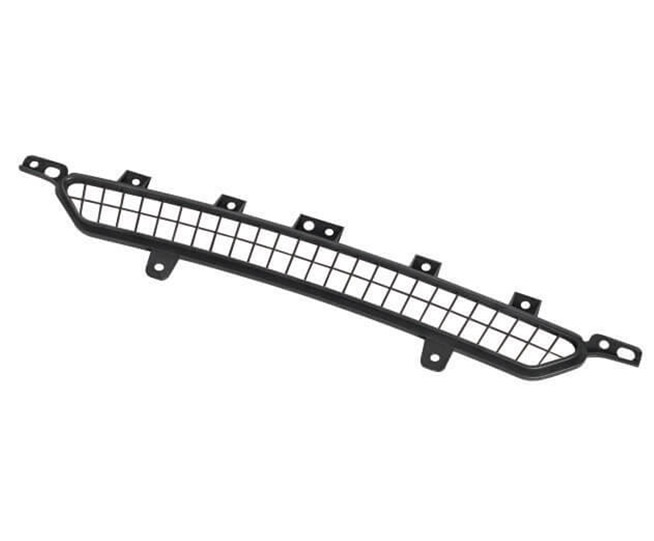
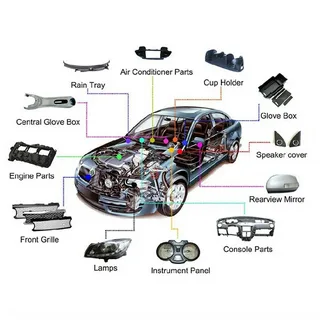
An automotive grille is a plastic exterior component that combines styling, airflow, protection, and assembly functions. Depending on its structure and position, it may be called a Car Grille, front grill, auto grill, or bumper grille. While the finished component may look relatively simple, producing it consistently requires a controlled plastic injection molding process, from mold Design and material selection to injection parameters and final inspection.
For automotive parts manufacturers, the challenge is not simply to produce one qualified grille. The objective is to develop an injection molding process that can repeatedly produce parts with stable dimensions, consistent surface quality, and reliable assembly performance.
For the grille discussed here, the specified material is PP+TF20, while the cavity uses 1.2738H steel with HRC 35–38 hardness. These specifications directly influence the design of the automotive injection mold and the subsequent molding process.
Automotive injection molding is a manufacturing process in which thermoplastic material is heated until it becomes molten and then injected into a precisely machined mold cavity under controlled pressure.
After the material fills the cavity, it is packed and cooled before the mold opens and the molded part is ejected.
The process is widely used for automotive injection molding parts because complex geometries can be produced repeatedly with relatively high dimensional consistency.
A grille is a typical example. Its geometry may include ribs, clips, mounting holes, decorative openings, reinforcing structures, and mesh patterns. With an appropriately designed plastic injection mold, many of these features can be formed in a single molding cycle.
In plastic injection molding, the mold is not simply a Tool that gives the part its shape. It controls how molten plastic flows into the cavity, where pressure is applied, how heat is removed, and how the finished part is ejected.
For this automotive grille, the tooling specification is:
| Mold Specification | Details |
|---|---|
| Part Name | Grille |
| Part Material | PP+TF20 |
| Cavity Steel | 1.2738H |
| Cavity Hardness | HRC 35–38 |
| Standard | MISUMI |
A properly developed injection mold design needs to consider the product geometry and the material behavior simultaneously.
Gate location, runner balance, venting, cooling channels, parting lines, ejector positions, sliders, and inserts can all influence the final molded part.
PP+TF20 is a polypropylene-based material reinforced with talc. The reinforcement can improve stiffness and dimensional stability, but it also affects material flow and shrinkage.
During the injection molding process, the molten material must travel through the runner system and fill different areas of the grille cavity.
If the flow is unbalanced, some areas may fill earlier while others fill later. This can contribute to weld lines, uneven packing, short shots, or dimensional differences.
The material's cooling and shrinkage behavior must also be considered.
For large automotive grilles, different sections of the part may have different wall thicknesses. If these areas cool at different rates, internal stresses and uneven shrinkage can contribute to warpage.
Therefore, PP+TF20 should be considered during the initial injection mold design rather than treated as a material issue only after trial molding.
A successful automotive injection mold begins with a detailed review of the product design.
Engineers normally evaluate:
Wall thickness
Draft angles
Ribs and bosses
Mounting clips
Holes and openings
Undercuts
Parting lines
Gate locations
Ejection positions
Cooling requirements
Venting locations
For custom automotive grills, these factors can become more complicated because styling requirements often create irregular surfaces and detailed structures.
A grille incorporating automotive grill mesh may contain many narrow openings. These areas require sufficient draft and appropriate machining access while still reproducing the intended appearance.
The mold must therefore balance product styling requirements with injection molding manufacturability.
Gate design has a direct influence on the injection molding process.
When molten PP+TF20 enters the cavity, it needs to reach different sections with an appropriate flow pattern. The gate position determines the initial direction of material flow and can influence pressure distribution and weld-line locations.
For a large Car Grille, placing the gate in an unsuitable location may create visible flow marks or weld lines on important appearance surfaces.
For this reason, gate design should be evaluated according to the actual geometry of the part.
Runner balance is also important when multiple gates are used. If different flow paths have significantly different resistance, filling may become unbalanced and produce dimensional variations.
Cooling is one of the most important aspects of injection molding quality control.
After filling and packing, the molded plastic must release heat before the part can be ejected. The cooling rate influences cycle time, shrinkage, residual stress, and dimensional stability.
For a large front grill, uneven cooling can produce deformation across the part.
Cooling channels should therefore be positioned according to the geometry and wall thickness of the molded component. Areas with greater thermal mass may require different cooling considerations from thin sections.
In PP+TF20 molding, cooling balance is particularly important because the reinforced material can behave differently from unfilled PP during shrinkage.
Air inside the cavity must escape as the plastic fills the mold.
If the mold has insufficient venting, trapped air can contribute to several injection molding defects, including burn marks, incomplete filling, poor surface quality, and localized defects.
This can be particularly challenging for complex bumper grille designs with narrow openings and deep structural features.
Other common injection molding defects include:
Short shots
Flash
Sink marks
Weld lines
Flow marks
Warpage
Burn marks
Dimensional variation
The important point is that these defects should not simply be corrected at the end of production. Their root causes should be identified through the relationship between mold design, material behavior, machine conditions, and process parameters.
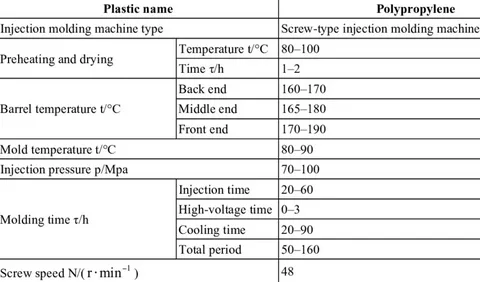
The injection molding process parameters determine how the material behaves during filling, packing, cooling, and ejection.
Important parameters may include:
Injection speed
Injection pressure
Melt temperature
Mold temperature
Holding pressure
Holding time
Cooling time
Screw speed
Back pressure
These parameters interact with one another.
For example, increasing injection speed may help fill a complex grille more quickly, but it can also influence shear heating, weld-line formation, and pressure distribution.
Increasing holding pressure may improve packing in some areas, but excessive pressure can affect dimensions or increase internal stress.
The objective is therefore not to maximize any single parameter but to establish a stable injection molding process window.
The production of the plastic injection mold normally includes several stages.
First, the mold design is developed according to the approved product geometry. The specified 1.2738H cavity steel is then prepared according to the required hardness.
CNC machining creates the major cavity and core features. EDM may be used for narrow slots, deep ribs, and other detailed areas that are difficult to produce through conventional milling.
After machining, the mold is assembled and checked for cavity-core alignment, parting-line fit, ejector movement, slider operation, insert positioning, cooling, and other critical functions.
The next stage is trial injection.
Trial molding allows engineers to compare actual molded parts with the product drawings and quality requirements. It also provides information about filling behavior, pressure requirements, cooling performance, warpage, surface appearance, and ejection.
Injection molding quality control should cover both the mold and the production process.
Dimensional inspection can include overall dimensions, mounting-hole positions, clip locations, wall thickness, and critical mating surfaces.
Appearance inspection can identify flash, sink marks, weld lines, flow marks, burn marks, scratches, and other visible defects.
For automotive components, assembly verification is equally important. A grille bumper may meet individual dimensional requirements but still create problems if it does not fit correctly with the surrounding bumper or body structure.
Production inspection should therefore combine dimensional, visual, functional, and assembly requirements.
A successful trial part does not automatically mean that the injection molding process is ready for long-term production.
During mass production, process parameters should remain within the validated process window. Material batches, machine conditions, mold temperature, cooling efficiency, and cycle time can all affect the finished part.
For high-volume automotive injection molding, regular inspection helps identify gradual changes before they result in large quantities of defective parts.
Mold maintenance is also part of the quality-control system. Wear around gates, ejectors, sliders, inserts, and cavity surfaces can eventually affect dimensions and appearance.
Monitoring these areas helps maintain consistent injection molding parts throughout the production cycle.
A custom automotive grills project should not be evaluated only from the perspective of appearance.
The product design needs to be compatible with the selected material and injection molding process.
For example, a grille with extremely thin sections may create filling difficulties. Large differences in wall thickness can increase the risk of sink marks or warpage. Deep ribs may require additional attention to draft and ejection.
Likewise, complex automotive grill mesh structures can increase machining and venting requirements.
A successful design therefore considers product appearance, structural requirements, material behavior, mold manufacturability, and production efficiency together.
The final quality of an automotive grille is not determined by one manufacturing step.
The product design affects the mold. The mold affects material flow. Material characteristics affect injection parameters. Cooling affects shrinkage and warpage. Process stability affects the consistency of finished parts.
This relationship is particularly important for PP+TF20 components manufactured with a 1.2738H HRC 35–38 cavity.
Whether the final product is a Car Grille, front grill, bumper grille, grille bumper, auto grill, or a grille incorporating automotive grill mesh, the objective of automotive injection molding is the same: to convert a defined product geometry into stable, repeatable, and production-ready molded parts.
For related information about automotive mold manufacturing, see Automotive Mold Manufacturing.
We attach great importance to the customers' demands for product quality and rapid production.
We always believe that meeting the customers' needs is the realization of our value!