


 English

News
Sat 09 , 2026
An unscrewing mold is an injection mold that releases internal threads by rotating the threaded core out of the molded part before ejection. Instead of stripping a part off a fixed core, the mold turns the core like a screw, so a continuous, full-depth thread can be molded without damage. Unscrewing molds are the standard solution for caps, closures, threaded fittings, and any plastic part whose thread must run unbroken around the inside wall.
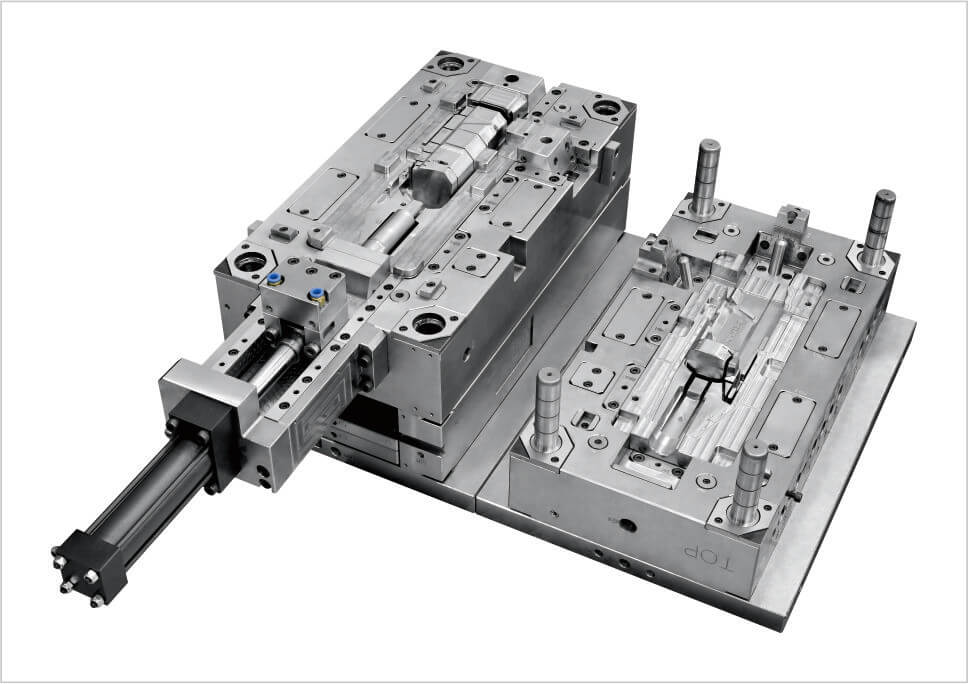
An unscrewing mold is a mold that carries a rotating threaded core, driven by a rack-and-pinion system, a hydraulic motor, or a servo motor. After the part has cooled, the drive turns the core so it unwinds from the internal thread, the core retracts, and the part is ejected. Because the core rotates instead of pulling straight out, the mold can form internal threads that are a complete undercut — something a standard two-plate mold cannot do.
This is why the Tool is also called an unscrewing injection mold, a thread unscrewing mold, or a rotating core mold. The working principle is always the same: rotate to release, rather than force to release. If you are sourcing this type of tooling, our automatic thread removal mold case category shows the kind of threaded components we build.
In Europe and the UK the same tool is spelled unscrewing mould, and the Design work is often described as unscrewing mould design. The mechanism and the tooling are identical — only the spelling changes.
The unscrewing mechanism adds one controlled motion — rotation — to the normal open, close, and eject cycle. A typical sequence runs like this:
The mold closes and plastic is injected into the cavity around the threaded core.
The part cools to a temperature where the thread form is rigid enough to hold its shape.
The mold opens along the parting line while the part stays on the core side.
The unscrewing drive rotates the core, so the thread unwinds out of the part.
Once the core is fully free, it retracts (or the part is held and the core withdraws).
The part is ejected, and the core returns to its start position for the next shot.
The critical detail is the ratio between thread turns and core rotation. A single-start thread needs many full rotations to release, while a multi-start thread releases in far fewer turns. That difference directly controls cycle time, which is the main cost penalty of an unscrewing mold.
Every detail of the injection mold unscrewing mechanism — thread starts, rotation speed, and core travel — is fixed during unscrew mold design, before any steel is cut. Changing it later means re-machining the core, so this is where the engineering effort belongs.
Three drive systems dominate unscrewing injection mold design. Each trades cost, control, and maintenance differently.
| Drive type | How it works | Best for |
|---|---|---|
| Rack and pinion | The mold opening stroke drives a rack that turns the core | Simple tools, moderate thread lengths |
| Hydraulic motor | A hydraulic motor drives the core through gears | Large parts, long threads, high torque |
| Electric servo | A servo motor controls rotation speed and position | Precision threads, tight tolerance, high volume |
A servo-driven unscrewing mold is the most controllable option: rotation speed, number of turns, and stop position are all programmed, which reduces the risk of thread damage on thin-wall caps. Rack-and-pinion designs are cheaper to build but tie release speed to the mold stroke, so they suit shorter, less demanding threads. Our mold manufacturing team matches the drive system to the thread geometry and expected production volume.
An unscrewing mold is the right choice when the internal thread must be continuous and full-depth. Typical cases include:
Bottle caps, screw closures, and tamper-evident caps with full internal threads
Cosmetic, pharmaceutical, and household packaging where the thread must seal reliably
Threaded fittings, pipe connectors, and adapters that assemble with a mating part
Medical components and electronic housings with sealed or load-bearing threads
If the thread is short, interrupted, or can tolerate a split, a collapsible core may be a faster and cheaper option. We compare the two approaches below.
Before a mold is cut, these factors decide whether the unscrewing mechanism runs smoothly in production:
Thread starts. Moving from a single-start to a two- or three-start thread can cut release time sharply without changing the thread's strength.
Core cooling. The core is surrounded by plastic, so it heats up quickly; poor core cooling slows the cycle and distorts threads.
Cycle time. Unscrewing adds time to every shot. On high-volume parts this is the main cost driver, so release speed is designed in from the start.
Drive clearance. Hydraulic and servo drives need space beside the mold, which affects mold base size and machine selection.
Material. Shrinkage and stiffness differ by resin, so thread fit is tuned to the specific plastic.
Tell us the thread type, part size, and annual volume, and we will recommend a drive system and cycle estimate before quoting. You can send your requirements through our quote request at any time.
Both tools release internal features that would otherwise lock the part in place. The difference is how they release, and that difference drives cost and cycle time.
| Factor | Unscrewing mold | Collapsible core |
|---|---|---|
| Release method | Core rotates out | Core segments collapse inward |
| Thread type | Continuous, multi-turn threads | Short or segmented threads, undercuts |
| Cycle time | Longer (rotation time added) | Shorter (no rotation) |
| Thread quality | Unbroken, full-depth thread | Fine witness lines at segment splits |
As a rule, choose an unscrewing mold for full, sealing threads and a collapsible core for shorter or interrupted threads where speed matters. We explain the collapsible core side in more detail in our guide to collapsible core injection molding.
An unscrewing mold fails in production, not on the drawing. When you evaluate an unscrewing mold supplier, ask for evidence of the points below.
| What to ask | Why it matters |
|---|---|
| Threaded-mold references | Proves real unscrewing experience, not just general mold making |
| In-house mold trial | Thread release must be tested before shipment |
| Drive system choice | Shows the supplier matches mechanism to your volume |
| Cycle time estimate | Reveals whether unit cost has been considered |
YouKing Mould has manufactured precision injection molds since 2006, producing 300 to 400 sets a year for customers in Europe, America, and Australia. Our tool shop builds unscrewing molds alongside 2K molds and Precision Components, and we run our own injection machines for mold trial and production, so thread release is verified in-house before a mold ships.
Because we also mold production parts, we design the unscrewing mechanism for the cycle time you will actually run, not just for a passing sample.
Send us your part drawing (2D or 3D), the thread specification, and your expected annual volume. We will review the thread for moldability, recommend a drive system, and come back with a mold design and quote. Share your details through our inquiry form or contact us directly, and our engineers will respond within one working day.
We attach great importance to the customers' demands for product quality and rapid production.
We always believe that meeting the customers' needs is the realization of our value!