


 English

News
Sat 10 , 2026

Automotive molds are specialized manufacturing Tools used to produce plastic, metal, and other components for vehicles. They play an important role in automotive manufacturing by helping produce parts with consistent dimensions, complex shapes, and repeatable quality.
From interior trim and exterior body components to electrical housings and functional parts, automotive molds support the mass production of components used in passenger cars, commercial vehicles, and electric vehicles.
Automotive molds are used to manufacture a wide range of vehicle components. Their applications depend on the material, component Design, and manufacturing process.
Interior components require accurate dimensions, consistent surface finishes, and compatibility with vehicle assembly structures.
Common molded interior parts include:
Dashboard components
Door panels and trim
Center console parts
Air conditioning vents
Interior switches and housings
For example, an injection mold can be designed to produce dashboard trim components with integrated clips and mounting structures, reducing the need for additional assembly operations.
Exterior automotive parts must meet requirements for dimensional accuracy, appearance, weather resistance, and mechanical performance.
Common applications include:
Bumper components
Grilles and decorative trims
Mirror housings
Door handle components
Exterior lighting housings
These components often require molds with carefully designed cooling systems, gating structures, and surface finishes to maintain consistent product quality.
Modern vehicles contain numerous electrical and electronic systems. Many of their plastic components are manufactured using precision injection molds.
Examples include sensor housings, connector housings, wiring protection components, and electronic control unit enclosures.
For electric vehicles, molded components are also used in battery-related electrical assemblies and charging system housings, depending on the application.
Automotive molds are also used to manufacture functional plastic components that support vehicle operation and assembly.
Examples include fluid reservoirs, brackets, clips, protective covers, and air duct components.
These parts may require specific mechanical properties, dimensional stability, and resistance to heat, vibration, or automotive fluids.
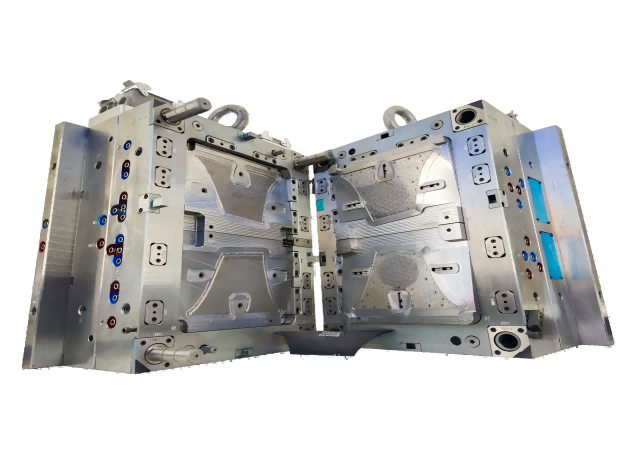
Different automotive components require different mold structures and manufacturing technologies.
Plastic injection molds are widely used to produce automotive interior parts, exterior trims, housings, and functional plastic components. Molten plastic is injected into a mold cavity and cooled to form the required shape.
2. Two-Color Injection Molds
Two-color molds are used to manufacture components combining two materials or colors in one molded product. They are commonly applied to automotive buttons, handles, decorative parts, and soft-touch components.
3. Overmolding Tools
Overmolding allows one material to be molded over another substrate. This process is useful for producing automotive components with soft-touch surfaces, protective layers, or integrated functional features.
4. Die Casting Molds
Die casting molds are used to manufacture metal components, commonly from aluminum or other suitable alloys. Applications include selected automotive housings, brackets, and structural components.
Material selection depends on the component's function, operating environment, and performance requirements.
Common automotive plastics include:
ABS: Used for interior trim, housings, and decorative components.
Polypropylene (PP): Common in bumpers, interior panels, and functional parts.
Polyamide (PA): Used for components requiring mechanical strength and heat resistance.
Polycarbonate (PC): Suitable for selected transparent and impact-resistant components.
PC/ABS: Combines properties of both materials and is used in various automotive housings and interior applications.
For example, a component installed near an engine may require greater thermal resistance than a decorative interior trim part. Therefore, material selection should consider the actual operating temperature and mechanical requirements.
Automotive components often need to fit with multiple surrounding parts. Small dimensional deviations can affect assembly accuracy, product appearance, and component functionality.
Precision mold design helps control several manufacturing factors:
Dimensional Accuracy: Maintains component dimensions and assembly tolerances.
Cooling Efficiency: Helps reduce uneven shrinkage and part deformation.
Mold Venting: Allows trapped air and gases to escape during injection.
Repeatability: Supports consistent production across large manufacturing batches.
For example, an automotive connector housing with multiple mounting points requires accurate positioning to ensure compatibility with the corresponding electrical assembly.
When selecting an automotive mold manufacturer, buyers should evaluate:
Experience with automotive injection mold projects.
Mold design and engineering capabilities.
Supported plastic materials and molding processes.
Precision machining and mold testing capabilities.
Quality inspection and dimensional measurement procedures.
Production lead times and after-sales technical support.
It is also useful to review previous automotive mold projects and request sample parts to evaluate dimensional accuracy and surface quality.
Automotive molds are essential manufacturing tools used to produce interior components, exterior parts, electrical housings, and functional vehicle components.
Different applications require different mold structures, materials, and manufacturing processes. Understanding these requirements helps automotive manufacturers select suitable mold solutions and maintain consistent component quality during production.
We attach great importance to the customers' demands for product quality and rapid production.
We always believe that meeting the customers' needs is the realization of our value!
Copyright © 2026 YouKing Mould Co., Ltd All rights reserved.| Sitemap| Sitemap
Privacy Policy / Cookie Policy / Terms & Conditions