


 English

Products
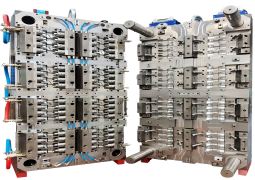
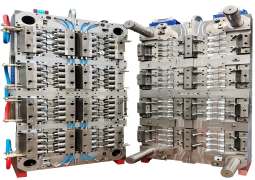
The Low Profile Adapter is a precision plastic component manufactured using PA6-GF30 and a high-cavity injection molding configuration. The tooling uses 32 cavities with 16 pcs INCOE open-tip hot runner gates combined with a cold runner system, providing a production-oriented solution for high-volume manufacturing.
The mold cavity is manufactured from 1.2343 ESR tool steel with HRC 50–52 hardness, while HASCO standards are used for the mold components.
For a small and precision-oriented component such as a low profile adapter, dimensional consistency is particularly important. With 32 cavities operating in the same mold, the challenge is not only producing an accurate individual part, but also maintaining consistency between all cavities throughout the production cycle.
A low profile adapter is generally Designed to provide a compact connection, transition, mounting, or interface between components while minimizing the overall height or occupied space.
The exact function depends on the application and product design. However, low-profile components typically place greater emphasis on dimensional accuracy because their compact geometry can contain relatively small mating surfaces, openings, locating features, or connection structures.
When such components are produced using plastic injection molding, the mold must reproduce these features consistently across every cavity.
The specified material for this component is PA6-GF30, a glass-fiber-reinforced nylon 6 material.
Compared with unreinforced PA6, PA6-GF30 provides increased stiffness and strength, making it suitable for engineering applications where mechanical performance is important.
However, glass-fiber-reinforced materials also introduce additional considerations during the injection molding process.
The glass fibers can influence:
Material flow
Shrinkage
Warpage
Dimensional stability
Surface appearance
Fiber orientation
For a 32-cavity mold, these factors need to be considered together with runner balance, gate configuration, cooling, and processing parameters.
One of the most significant characteristics of this tooling is its 32-cavity configuration.
Multi-cavity molds are designed to produce multiple parts during each injection cycle, improving production efficiency when large quantities are required.
However, increasing the cavity count also increases the requirements for mold balance and process control.
All 32 cavities need to receive a suitable amount of molten PA6-GF30 under controlled filling conditions.
If the flow resistance between cavities is not sufficiently balanced, differences in filling time and pressure can occur. This may result in variations in:
Part weight
Dimensions
Packing
Shrinkage
Surface quality
For this reason, multi-cavity injection mold design requires careful attention to runner layout, gate position, cooling balance, and cavity geometry.
The mold uses 16 pcs INCOE open-tip gates combined with a cold runner system.
The relationship between the hot runner and cold runner needs to be carefully designed so that the molten material can be distributed consistently to the 32 cavities.
With 16 gates serving 32 cavities, the runner system needs to provide a balanced flow path from the injection unit toward the individual cavity gates.
For PA6-GF30, this becomes particularly important because the glass-fiber-filled material has different flow characteristics from standard unfilled thermoplastics.
Gate positioning can also influence fiber orientation, weld-line location, filling behavior, and the dimensional characteristics of the molded adapter.
Runner balance is one of the fundamental considerations in precision injection molding.
In a multi-cavity mold, the ideal condition is for the cavities to fill in a controlled and repeatable manner.
If one cavity fills significantly earlier than another, the pressure and packing conditions may differ between cavities.
This can lead to cavity-to-cavity variations even though all 32 cavities are theoretically producing the same component.
A well-developed runner system therefore helps establish a more consistent molding environment across the complete mold.
The cavity uses 1.2343 ESR steel with a hardness of HRC 50–52.
1.2343 is a hot-work tool steel commonly used in tooling applications requiring a combination of toughness, thermal resistance, wear resistance, and dimensional stability.
The ESR material condition can provide a more controlled steel structure for demanding tooling applications.
For a high-cavity plastic injection mold, cavity steel selection is important because the mold may undergo a large number of injection cycles.
The specified HRC 50–52 hardness also needs to be considered during machining, polishing, maintenance, and long-term mold operation.
Glass-fiber-reinforced PA6 requires different considerations from conventional plastic materials.
During injection, the glass fibers tend to orient according to the direction of material flow. This orientation can influence shrinkage and mechanical properties in different directions.
Consequently, the relationship between gate location and part geometry is important.
For a low profile adapter with small functional features, uncontrolled fiber orientation or uneven shrinkage can affect dimensional accuracy.
The mold designer therefore needs to consider:
Gate position
Flow direction
Wall thickness
Cooling layout
Ejection system
Expected shrinkage
Part orientation
These factors should be evaluated together during injection mold design.
Cooling becomes increasingly important as cavity numbers increase.
The mold needs to remove heat consistently from all 32 cavities while maintaining an appropriate cycle time.
Uneven cooling can produce cavity-to-cavity differences in shrinkage and warpage.
For PA6-GF30, cooling conditions also influence dimensional stability and cycle efficiency.
A well-designed cooling system should therefore provide reasonably consistent thermal conditions across the mold rather than focusing only on individual cavity cooling.
Quality control for a 32-cavity mold requires both individual-part inspection and cavity-to-cavity comparison.
Important inspection items may include:
Overall dimensions
Critical mating dimensions
Part weight
Hole and opening dimensions
Warpage
Flash
Short shots
Weld lines
Surface defects
Gate condition
Part weight can also be useful as a process-monitoring indicator. Significant differences between cavities may indicate variations in filling or packing conditions.
For precision injection molding parts, the objective is not only to confirm that one cavity produces a qualified part, but to verify that the entire mold can maintain consistent output.
Before mass production, the mold should undergo trial molding to verify filling, runner balance, cooling performance, ejection, and dimensional stability.
For a 32-cavity tool, trial molding should pay particular attention to cavity-to-cavity variation.
Engineers can compare part weights, dimensions, appearance, and filling behavior across different cavity positions.
Process parameters such as:
Injection speed
Injection pressure
Melt temperature
Mold temperature
Holding pressure
Holding time
Cooling time
can then be optimized to establish a stable injection molding process window.
For PA6-GF30, material preparation and drying conditions are also important because nylon materials are sensitive to moisture.
A high-cavity mold is ultimately designed to provide efficient and repeatable production.
The combination of 32 cavities, 16 INCOE open-tip gates, a cold runner, PA6-GF30, and 1.2343 ESR HRC 50–52 cavity steel represents a tooling configuration focused on producing engineering plastic parts at production scale.
The performance of the mold depends on the interaction between cavity geometry, runner balance, gate design, cooling, material preparation, injection parameters, and mold maintenance.
For this reason, high-volume plastic injection molding requires process control throughout the entire production cycle rather than relying only on final inspection.
The Low Profile Adapter demonstrates the technical requirements involved in producing small engineering plastic components with a high-cavity mold.
From PA6-GF30 material behavior and fiber orientation to 32-cavity runner balance, INCOE open-tip gating, cooling, mold steel, and cavity-to-cavity inspection, each factor can influence the consistency of the final injection molded parts.
For precision custom injection molding, a stable relationship between product design, mold structure, material, and process parameters is essential for achieving repeatable production quality.