


 English

News
Thu 10 , 2026
Medical plastic parts are not judged on appearance. A tray, a tube, a housing or a connector either meets its dimensional and material specification on every batch, or it fails — and in a medical context a failed part is not a cosmetic problem. That is why medical injection molding is specified differently from general-purpose molding: the material has to be traceable, the dimensions have to repeat, and the documentation has to travel with the parts. This guide explains what makes medical plastic molding different, what Tooling it requires, and how to evaluate a supplier before you commit a program to them.
The process is the same injection molding that makes any other plastic part. What changes is the tolerance for variation. In general-purpose molding a small dimensional drift or a slightly different material lot is usually invisible to the end user. In medical injection molding it is a specification failure, and it is the reason the following four requirements appear in almost every medical plastic parts program:
Material traceability. Every batch of resin has to be traceable back to its lot, and the grade has to be a medical grade rather than a general-purpose grade of the same polymer. Substituting an equivalent-looking resin is not an option.
Batch-to-batch dimensional consistency. The tenth production run has to measure like the first. This puts the requirement on the tool and the process, not on inspection: you cannot inspect consistency into a part.
Documentation. First article inspection reports, dimensional reports and material certificates are part of the deliverable, not a favour. If a supplier cannot issue them, the part is not ready for a medical supply chain.
Change control. Once a medical plastic component is qualified, any change to the tool, the material or the process has to be agreed in advance. A toolmaker who silently reworks a cavity after qualification creates a problem that can invalidate the customer's own approvals.
Most medical plastic components are molded from a small group of engineering polymers, chosen for how they behave under sterilization and how they interact with the fluids and tissues they meet. The common choices are:
| Material | Typical medical use | Why it is chosen |
|---|---|---|
| PP | Trays, closures, fluid containers | Chemical resistance, autoclavable |
| PC | Housings, connectors, transparent covers | Clarity, impact strength, dimensional stability |
| POM | Precision mechanical components | Low friction, tight tolerance, stiffness |
| PEEK | Reusable instruments, high-temperature parts | Withstands repeated steam sterilization |
| PC/ABS | Equipment enclosures | Balance of toughness and moulding ease |
The material decision is not only about the polymer family. Two suppliers quoting “PP” may be quoting grades with different additive packages, different melt flow and different biocompatibility documentation. Specify the grade, not the family, and ask for the material certificate before the first trial run.
A medical plastic mould is built to hold tolerance over a long production life, and medical mould tooling requirements follow from that single constraint. Several tooling decisions flow from it.
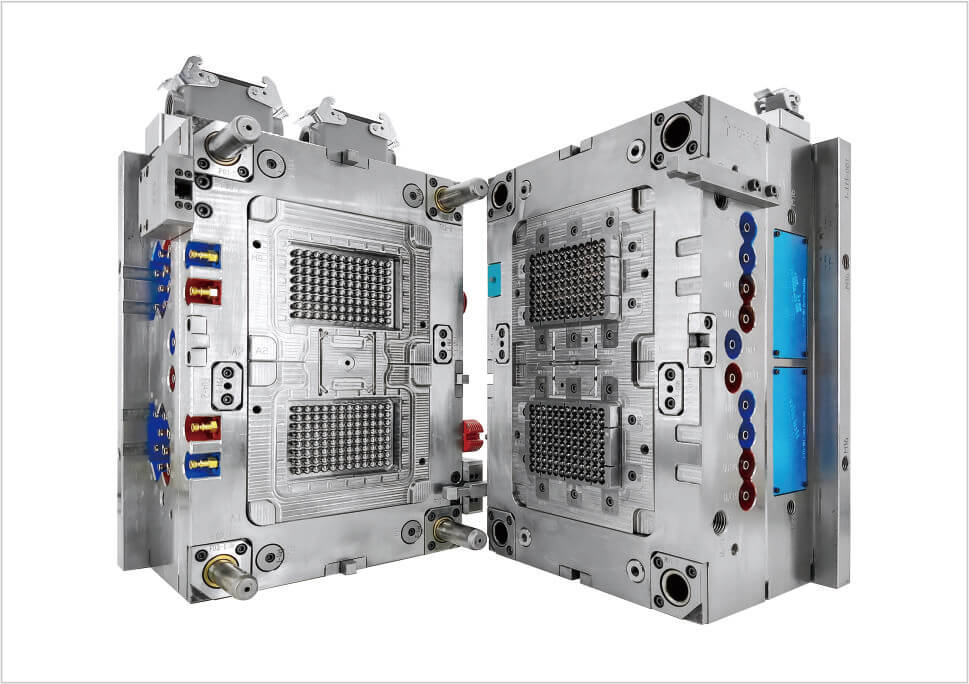
Cavity count. Medical parts are usually high-volume, so multi-cavity tools are common. A higher cavity count lowers unit cost but raises the demand on balance between cavities — an unbalanced multi-cavity tool produces parts that differ from one cavity to the next, which is exactly the variation medical programs cannot accept. The tooling shown in our medical tray mould project is a good example of how cavity layout is planned around consistency rather than around maximum output.
Steel grade and cooling Design. Harder steels hold dimensional accuracy longer; a well-designed cooling circuit keeps the part from warping and keeps cycle-to-cycle shrinkage repeatable. On tight-tolerance medical parts, cooling design is often the difference between a tool that measures consistently and one that needs constant adjustment.
Runner design. Hot runner systems reduce scrap and improve consistency on small, high-cavity parts; cold runners are simpler and cheaper to maintain. The right answer depends on the part size and the annual volume, and it should be argued in the design review rather than defaulted.
Surface finish. Where a medical part is a fluid path or a sealing surface, the cavity finish is a functional specification. It needs to be written into the tool drawing, not left to the polisher's judgement.
Medical plastic parts quality control is built in three layers, and a supplier should be able to describe all three.
The first layer is the tool and the process: a balanced multi-cavity tool, a stable cooling design and a locked process window mean the parts come out consistent without anyone inspecting them into shape. The second layer is measurement: dimensional inspection against the drawing, using equipment capable of the tolerances on the print, with results recorded rather than eyeballed. The third layer is documentation: a first article inspection report at the start of production, dimensional reports that travel with the batches, and material certificates on file.
When you audit a supplier, ask which of these three layers they own. A supplier who owns the tool, runs the trial and measures the result in the same facility can close the loop quickly. A supplier who outsources the tool has to coordinate three parties before a dimension can be corrected.
Use this list as a checklist in the first technical conversation. It is deliberately about capability rather than certificates, because capability is what determines whether the parts will measure the same in month twelve.
| What to check | Why it matters | What to ask |
|---|---|---|
| Material grade and source | Traceability depends on the grade, not the family | Which exact grade, and can you supply the certificate? |
| Tool built in house | Outsourced tools slow every correction | Do you design and cut the mould yourself? |
| Moulding capacity | Trial runs compete with production for machine time | How many machines, and how long is the wait for a trial? |
| Measurement equipment | Tolerances cannot be verified without the right instruments | What do you measure with, and do you issue a report? |
| Batch consistency | The tenth run has to match the first | How do you control shrinkage and cavity balance? |
| Change control | Unannounced tool changes break customer approvals | How do you handle a cavity repair after qualification? |
| Path from trial to volume | A separate pilot tool doubles the cost of validation | Can the same tool run the trial and the production order? |
A medical program is easier to quote, and easier to audit, when the first conversation starts with documents rather than impressions. The following package lets a supplier give you a tooling estimate that reflects the real requirement instead of a guess:
The 3D model and the 2D drawing with tolerances. The drawing states which dimensions are critical, and critical dimensions are where the tooling cost and the inspection plan come from.
The material grade, not just the polymer family. Grade, filler and melt flow decide the shrink rate, and the shrink rate decides the cavity dimensions.
Sterilization method and cycle count. Steam autoclave, ethylene oxide and gamma irradiation stress a polymer differently, and a reusable part has to survive repeated cycles, not one.
Expected annual volume and product life. This sets the cavity count and whether the tool should be hardened for a long production life.
The documentation you are expected to file. If your own approval process needs a first article inspection report, dimensional reports or material certificates, say so at the start so the supplier prices them in rather than treating them as an extra.
YouKing Mould has manufactured injection moulds in Dongguan, China since 2006, with 5,500 square metres of floor space and 27 injection moulding machines, including 20 single-color and 7 two-color machines. Medical work runs through the same in-house chain as every other program: mould design, steel cutting, EDM, fitting, trial run and measurement, all under one roof.
The medical components we have tooled include a multi-cavity medical tray mould in PP and a medical tube component, both built with tight wall-thickness control and dimensional inspection before shipment. If your part is in the same family — trays, tubes, housings, connectors or precision mechanical components — the tooling approach transfers directly.
As a medical mould manufacturer running a custom medical injection molding program, the question we ask first is not what the part looks like but what has to stay true in month twelve. That question shapes the steel, the cooling and the inspection plan before a single cavity is cut.
If you are still shortlisting suppliers, our guide to choosing a custom injection mould manufacturer covers the commercial side of that decision, and the custom injection mould tooling page shows the range of tools we build.
Medical injection molding is general-purpose molding with the tolerance for variation removed. The material has to be specified by grade and traceable to its lot, the tool has to be balanced enough that all cavities produce the same part, and the measurements have to be recorded rather than assumed. None of that is exotic — but all of it has to be designed in from the start, because it cannot be inspected in later.
If you have a medical plastic component in development, send us the 3D file, the drawing with its tolerances, the target material grade and your expected annual volume. Our engineering team will review the part for mouldability, propose a cavity layout and cooling design, and come back with a tooling and unit-cost estimate you can compare against your other quotes.
We attach great importance to the customers' demands for product quality and rapid production.
We always believe that meeting the customers' needs is the realization of our value!