


 English

News
Tue 09 , 2026
Automotive injection mold Tooling is not bought the way a consumer product tool is bought. A housing for a household appliance can tolerate a small dimensional drift between batches. A busbar holder, a valve block, or a structural support frame that goes into a vehicle cannot, because the part has to fit an assembly line that runs for years, and because a field failure is recalled, not returned. This guide sets out what an automotive buyer should verify before placing an order — and the questions that separate a supplier who understands automotive requirements from one who has simply quoted a price.
The scope of automotive injection molding is wider than most first-time buyers expect: structural frames, electrical and busbar housings, interior trim, under-hood components, lighting parts and fluid-handling components all sit in the same category. What they share is that automotive plastic injection molding is validated as a system rather than as individual parts — a tolerance that looks generous on a drawing becomes tight once it has to stack with three other components in a fixture.
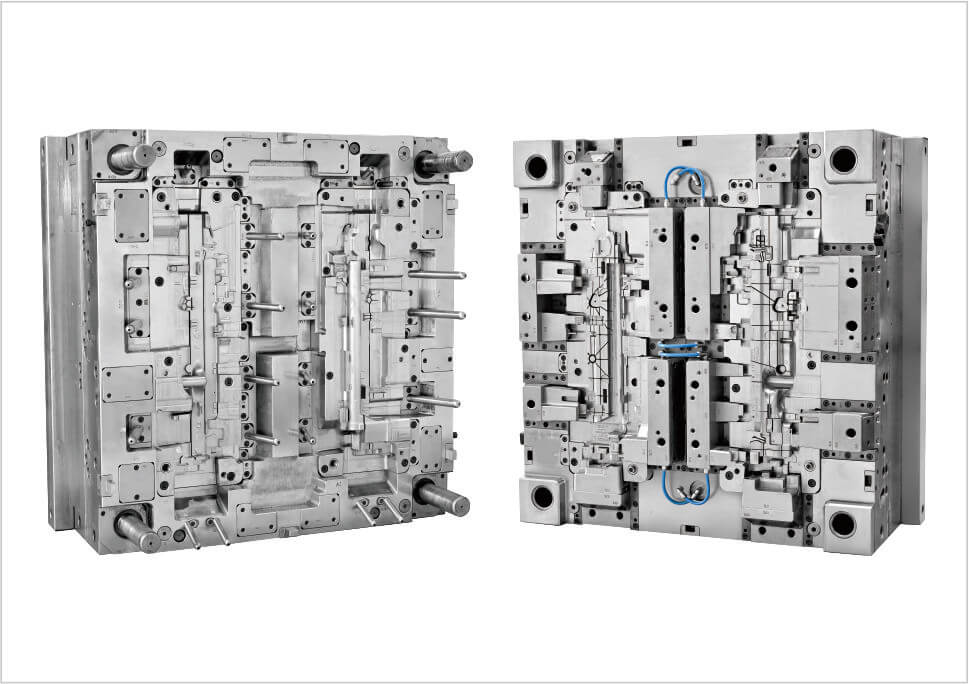
Three characteristics separate automotive plastic parts from almost every other category of molded component.
First, the mold must hold its geometry across a very long production life. Automotive programs are planned for multi-year volumes, and a tool that drifts out of tolerance after 200,000 shots is a problem the buyer inherits, not the mold maker. Second, the part is judged against a tolerance stack, not on its own. It has to assemble with parts made by other suppliers, in a fixture, on a line, with no rework. Third, any change after approval has a cost. Once a part is validated and tooling is signed off, changing a gate position or a cooling layout means re-qualification, and automotive customers do not accept that casually.
The practical consequence is that automotive tooling is evaluated on repeatability and documentation as much as on cavity geometry. A tool that makes one good sample set is not the deliverable. A tool that makes the same good part on shot 1, shot 50,000 and shot 300,000 is.
The differences are concentrated in a handful of Design decisions that are made before steel is cut.
| Design area | Automotive requirement | Why it differs |
|---|---|---|
| Cooling layout | Balanced circuits, often baffled or with conformal inserts | Uneven cooling produces differential shrinkage and warpage |
| Gating | Balanced gates, often hot runner for family tools | Gate position sets weld line location and fiber orientation |
| Ejection | Ejector plates sized for higher clamp and cycle loads | Distortion at ejection shows up as dimensional drift |
| Steel selection | Hardened tool steel for high-volume, abrasive or glass-filled resins | Mold life is a contractual number, not an aspiration |
| Surface finish | Specified texture, consistent across both halves | Visible automotive parts are matched to a master sample |
| Slides and lifters | Wear plates, hardened inserts, accessible maintenance | Undercuts on structural parts are common and heavily loaded |
You can see how these decisions play out on real parts in our case pages for automotive busbar holder molds and automotive valve block and manifold molds.
This is the automotive injection mold tooling checklist worth working through with every candidate supplier. Each line is something that is cheap to check now and expensive to discover later.
| What to verify | What to ask | Red flag |
|---|---|---|
| Mold flow analysis | Will you run fill, packing and warpage simulation before cutting steel? | Warpage predicted only after the first trial |
| DFM feedback | Will you return a written DFM report with draft, wall and tolerance comments? | Quote issued with no design comments at all |
| Steel grade and hardness | Which steel for cavity and core, and at what hardness? | "Standard steel" with no grade named |
| Mold life commitment | What shot count is guaranteed, and against what maintenance schedule? | A number with no maintenance terms attached |
| Trial and first article | Will you provide a dimensional report and first article inspection? | Sample photos offered instead of measured data |
| Process capability | Can you show Cp/Cpk on the critical dimensions? | Capability discussed only in general terms |
| Documentation | Do you hold IATF 16949, and can you support PPAP documentation? | Quality system described but never named |
| Change control | How are engineering changes recorded and approved after sign-off? | No defined change process |
| Tool ownership | Who owns the tool, and what happens if we move production? | Ownership left vague in the contract |
Automotive mold dimensional stability is not a property of the steel — it is the outcome of four things working together: a balanced cooling layout, a gate position that produces a symmetric flow front, a packing profile that compensates for shrinkage, and a clamp and ejection system rigid enough not to deflect under load.
When a structural part drifts, the cause is usually traceable to one of these. Differential cooling on one side of a boss, a gate that fills one end of the part before the other, or a packing profile copied from a different part geometry will all show up as warpage — and warpage that appears after 100,000 shots usually means the tool is moving under load, not that the process has changed.
This is the reason to ask for mold flow analysis output rather than a verbal assurance. If warpage was predicted and corrected in simulation, the tool arrives with a known starting point. If it was not, the trial becomes an expensive experiment. Our article on what makes automotive structural mold parts reliable goes deeper into the failure patterns.
A supplier can deliver a perfect first article and still be unusable if batch 20 does not match batch 1. Consistency depends on process control discipline: documented parameters locked to the tool, not adjusted shot by shot by an operator; resin dried and handled to a recorded procedure; regrind percentage controlled and declared; and inspection sampling that runs at a defined frequency rather than at the end of the order.
Ask to see a process parameter sheet for a comparable part the supplier has already run. A supplier who can produce one immediately is running a controlled process. A supplier who has to build it for you is describing what they intend to do.
Mold life is a commercial number and should be quoted as one. As a rough guide, automotive tools running unfilled resins at moderate volumes can be built from pre-hardened steel in the 30-34 HRC range, while high-volume tools, glass-filled resins and abrasive materials justify hardened tool steel in the 48-54 HRC range with hardened slides and wear plates. The gap between the two is not cosmetic: it changes both tooling cost and how often the tool comes out for maintenance.
The right question is not "what is the best steel" but "what steel gives me the life I need at the volume I am planning, with the maintenance I am willing to schedule". A supplier who answers that question with a number and a maintenance plan is doing engineering. One who answers with a brand name is doing sales.
Warpage discovered at trial, not at simulation. Correcting it means reworking cooling or gating on a finished tool.
Tolerance defined on the part but not on the mold. Without a mold-specific tolerance budget, disputes have no objective reference.
No agreed first article standard. The supplier measures one way, the buyer measures another, and both are technically correct.
Maintenance plan absent from the quotation. Spare cores, slides and hot runner components have long lead times and should be specified up front.
Tool ownership undocumented. Moving a tool between molders is routine in automotive, and it should be straightforward by contract.
Textured surfaces approved from a photo. Texture should be approved against a physical master sample or a defined SPI grade.
For an automotive program, the qualification question is whether design, tooling and molding sit under one roof. Automotive problems are cross-functional: a dimensional drift can originate in cooling design, in steel choice, or in the molding process, and if three different companies own those three areas, nobody owns the result. The automotive injection mold manufacturers worth shortlisting are the ones who can answer process questions as well as tooling questions — because the two are not separable in a program that runs for years.
A practical test when you evaluate an automotive tooling supplier: ask about a part they have already run to high volume, and ask what went wrong on it. A supplier with real production experience will have a specific answer — a cooling change, a gate moved, a steel grade upgraded after a wear issue. A supplier who describes every past project as trouble-free is either new to automotive work or not being candid.
YouKing Mould has manufactured molds in Dongguan, China since 2006, building 300 to 400 molds a year across automotive, electronics and industrial applications. Design, tooling, Precision Components and production trials are handled in house, on 27 injection molding machines including 7 two-color machines, which means a tool can be designed, built, trialed and moved into production without changing hands. You can review our automotive injection mold tooling and our mold design and mold flow analysis capabilities before you send a drawing.
If you have an automotive part moving toward tooling, send us the 3D file, the 2D drawing with critical dimensions, the target material and the annual volume. We will come back with a DFM review and a tooling quotation that states the steel grade, the mold life and the maintenance terms — not just a price.
How long does an automotive injection mold take to build?
It depends on part complexity and the number of slides, but automotive tools generally take longer than consumer tools of the same size because of the simulation work, the tighter tolerance budget and the documentation. Ask for the trial date in writing rather than a total lead time.
Is mold flow analysis always necessary?
For structural automotive parts, yes. For simple cosmetic covers, a well-established design can be quoted without it — but the supplier should be able to explain why it is not needed.
What mold life should I specify?
Base it on your program volume plus a maintenance margin, not on a generic number. A tool specified for 500,000 shots with a maintenance plan is more useful than one specified for 1,000,000 shots with no plan.
Can a mold be moved to another molder later?
Yes, if the tool is built to a standard mold base and the water and ejector circuits are documented. Make sure ownership and data transfer are in the contract.
Do I need PPAP documentation?
If you are supplying a vehicle manufacturer or a tier supplier, usually yes. Confirm early whether your chosen molder can support the documentation set, because it affects the trial and first article plan.
Automotive injection mold tooling is bought on repeatability, not on sample quality. The parts of the decision that matter most — simulation before steel, a written DFM report, a named steel grade with a stated mold life, an agreed first article standard, and documented change control — are all things you can ask about before you place an order, and all things that are difficult and expensive to fix afterwards.
Work through the checklist above with each candidate supplier, and treat vague answers as a genuine signal. If you would like a second opinion on a part you are about to tool, send us the drawing and we will return a DFM review with the tooling approach and the risks we see.
We attach great importance to the customers' demands for product quality and rapid production.
We always believe that meeting the customers' needs is the realization of our value!