


 English

Products
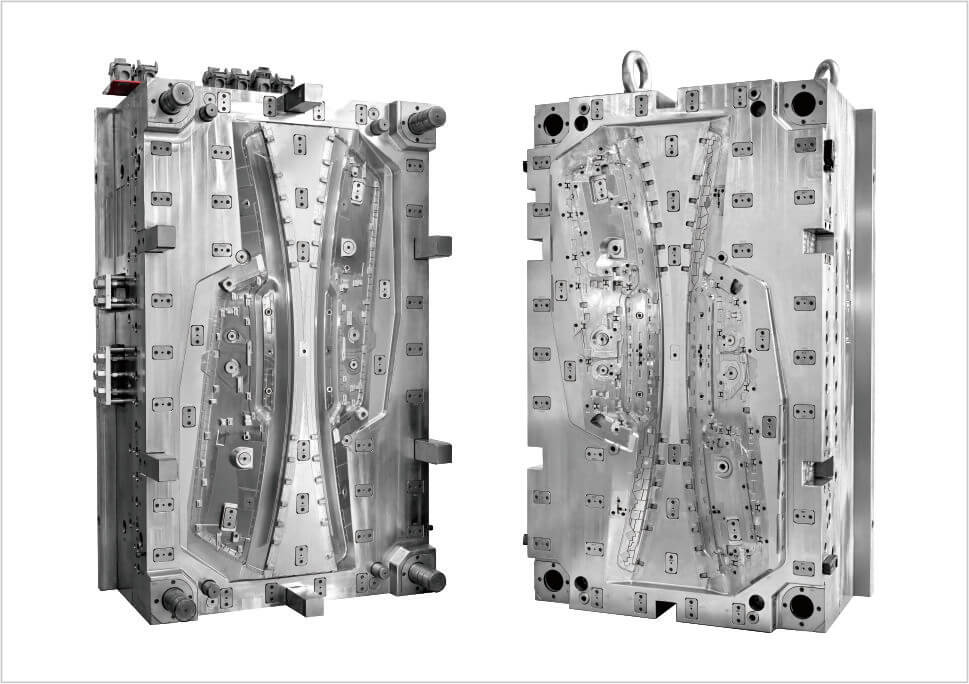
The BLENDE FRONT CENTERSPEAKER for BMW G6X is an automotive interior component requiring controlled dimensions, consistent surface quality, and reliable assembly performance. Its injection mold is developed for PC-ABS molding and OEM-oriented production, with particular attention to cavity consistency, material flow, and the appearance requirements of interior trim components.
Unlike structural automotive parts, speaker trim components are often judged not only by dimensional accuracy but also by the quality of visible surfaces and the consistency of surrounding gaps and interfaces. This makes mold construction and process stability equally important.
The component is designed for the BMW G6X platform and belongs to the automotive interior trim category.
For this type of component, the mold has to reproduce the product geometry accurately while maintaining a suitable molding condition for PC-ABS. Areas around the speaker opening, mounting structures, locating features, and visible surfaces require particular attention because dimensional deviations can affect both assembly and perceived interior quality.
The mold development therefore focuses on three connected requirements:
geometrical accuracy → controlled plastic flow → consistent production quality
This approach is particularly important when the molded component will be assembled with other interior parts.
PC-ABS combines characteristics of polycarbonate and ABS, making it widely used for applications requiring a balance of mechanical performance, dimensional stability, appearance, and processability.
For automotive interior injection molding, material behavior needs to be considered during mold development.
The material must fill the cavity consistently without creating unacceptable defects on visible areas. At the same time, cooling and shrinkage need to be controlled so that mounting features and interfaces remain within the required dimensional range.
For the BMW G6X center speaker trim, the mold design is therefore developed around the actual PC-ABS molding requirements rather than treating the material simply as a standard thermoplastic.
An interesting aspect of this tooling project is the change from an original concept using 10 pcs Synventive valve gates to a cold runner with sub-gate configuration.
Gating is one of the most influential elements in an injection mold because it determines where molten plastic enters the cavity and how the filling pattern develops.
For an automotive interior component, gate selection needs to consider more than filling efficiency. Gate position can influence:
Flow marks
Weld lines
Packing behavior
Surface appearance
Gate vestige
Part deformation
Cycle conditions
Production maintenance
A cold runner with sub gates can provide a different balance between tooling structure, filling behavior, gate location, and production requirements.
The final gating solution should always be evaluated against the actual geometry, material, appearance requirements, and production conditions of the component.
The mold uses a 2-cavity configuration.
Rather than simply maximizing the number of cavities, automotive tooling needs to balance production efficiency with cavity-to-cavity consistency.
With two cavities, the mold can produce two parts per cycle while maintaining a relatively manageable flow and cooling system.
The cavity arrangement and runner design need to be balanced so that both cavities receive comparable filling and packing conditions.
During mold trials, cavity-to-cavity comparison can include part weight, critical dimensions, appearance, and assembly-related features.
The cavity uses 1.2738HH steel with a hardness of HRC 33–38.
For automotive injection molds, cavity steel selection needs to consider expected production volume, material characteristics, machining requirements, surface finish, and mold maintenance.
The cavity surface is responsible for reproducing the visible geometry of the speaker trim. Therefore, machining accuracy and surface preparation are important factors in achieving consistent molded-part quality.
The selected steel also needs to maintain dimensional stability through repeated heating, cooling, injection pressure, and mold-opening cycles.
Automotive interior components often have a different quality focus from hidden structural parts.
A part may technically fit the assembly but still require further optimization if the visible surface contains unacceptable flow marks, weld lines, sink marks, or gate traces.
For a speaker trim component, the following areas can therefore require close attention:
Appearance surfaces
Visible areas need consistent texture and surface quality.
Speaker openings
The geometry around the speaker opening needs to remain dimensionally stable.
Mounting interfaces
Clips, locating features, and mounting structures must remain accurately positioned.
Parting line
The parting line should be controlled to minimize visible mismatch or flash.
Ejection
Ejection forces should be distributed appropriately to avoid deformation or surface damage.
The mold manufacturing process begins with reviewing the approved product geometry and determining an appropriate tooling structure.
CNC machining is used for the major cavity and core geometry, while additional machining processes can be applied where necessary for detailed features.
After mold assembly, the tooling is inspected for:
Cavity and core alignment
Parting-line condition
Runner and gate configuration
Ejector operation
Cooling circuits
Slider or insert movement
Critical cavity dimensions
Trial molding then provides the opportunity to evaluate actual PC-ABS filling behavior and compare the two cavities.
Process conditions can be adjusted based on the molded samples, with particular attention to appearance, dimensions, warpage, flash, and assembly fit.
For automotive interior injection molding, quality control should cover both the mold and the molded component.
Dimensional inspection can focus on critical mounting points, speaker openings, overall dimensions, and mating surfaces.
Appearance inspection can identify:
Flow marks
Weld lines
Sink marks
Flash
Burn marks
Scratches
Gate traces
Surface inconsistencies
For OEM applications, these inspections are not independent from one another. A surface defect may be unacceptable even when the component remains dimensionally correct, while a small dimensional deviation may become significant during assembly.
The final inspection criteria therefore need to reflect the functional and visual requirements of the complete vehicle interior system.
The BMW G6X center speaker trim mold demonstrates how an automotive injection mold needs to balance part appearance, dimensional accuracy, material behavior, gating strategy, cavity configuration, and production stability.
The combination of PC-ABS, a 2-cavity mold, cold runner with sub gate, and 1.2738HH HRC 33–38 cavity steel provides a tooling configuration developed around the requirements of an automotive interior component.
For similar automotive injection molding projects, the most important consideration is not simply the number of cavities or the type of runner. The entire mold needs to work as an integrated system from filling and cooling through ejection, inspection, and mass production.
For OEM customers developing automotive interior components, Youking Mould provides support covering automotive injection mold design, mold manufacturing, trial molding, and production-oriented tooling development.
Explore Automotive Injection Molding Solutions