


 English

News
Tue 09 , 2026
Two-shot molding and overmolding both put two different plastics into one finished part, and buyers often treat them as interchangeable. They are not. The difference is not a detail of wording — it decides how many machines your Tooling needs, how tightly the two materials must bond, how much you pay for the mold, and how much freedom you have to change the part later. This guide explains how each process works, where each one wins, and what to ask a supplier before you commit to a tool.
The short answer: two-shot molding forms both materials in one mold during one machine cycle, while overmolding forms the second material onto a substrate that already exists. In two-shot molding the substrate and the second material meet as molten plastic inside a single tool. In overmolding, the substrate is a finished part — either molded earlier or bought in — and the second material is injected around it in a second mold and a second cycle.
That single structural difference cascades into everything else: the number of molds, the number of machines, the bonding mechanism, the cycle time, the tooling cost and the minimum order quantity that makes sense. If you are comparing overmolding vs two-shot molding for a new program, this is the decision that has to be made first, before part Design is frozen.
One note on terminology, because it causes real confusion during sourcing. The process is written both as two shot molding and two-shot molding, and in the UK and Europe as two shot moulding — all three describe the same tool. Separately, overmolding vs insert molding is a different comparison: insert molding normally places a metal insert into the cavity, while overmolding places a plastic substrate. Our guide to plastic injection overmolding covers that distinction in full, and it is worth reading before you shortlist suppliers.
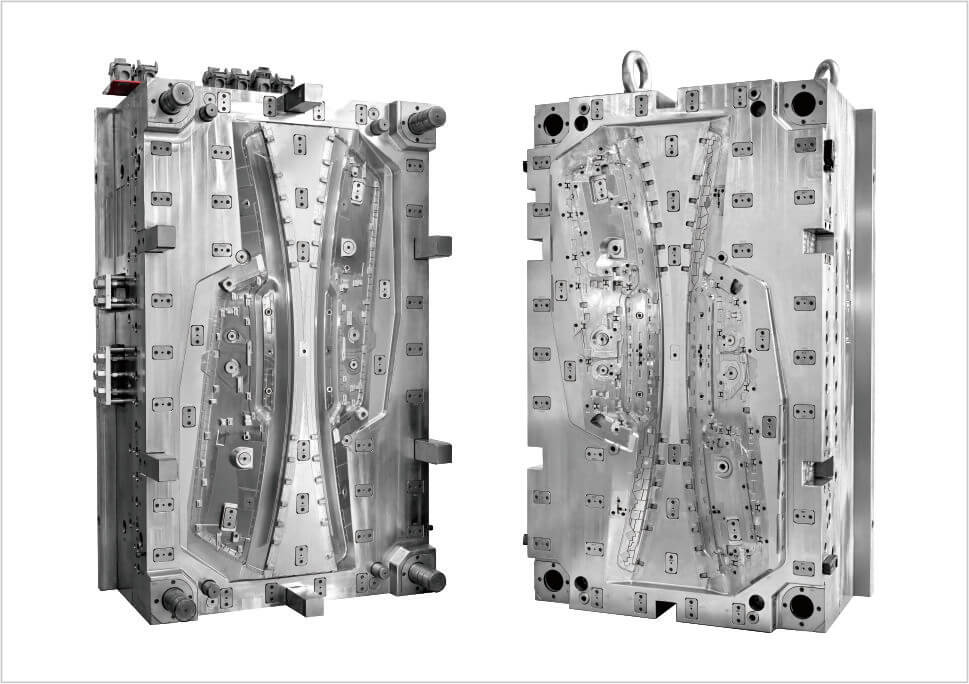
A two-shot mold — also called a 2K mold or a two-color mold — runs on a dedicated two-shot injection molding machine with two injection units. The mold has two cavities or two sets of cavities that are linked by a rotating platen, a sliding core, or a turntable.
The sequence is straightforward once the tool is running:
The first injection unit fills the substrate cavity with material A.
The mold opens and the moving half rotates or shifts, carrying the partly formed substrate to the second station.
The second injection unit injects material B directly onto the substrate, still inside the same tool.
The part cools as a single bonded component and ejects in one piece.
Because the second material is injected onto a substrate that is still hot and chemically receptive, two-shot molding produces the strongest possible bond without primers or adhesives. It also holds the tightest dimensional relationship between the two materials, because both are formed against the same steel in the same cycle. Our 2K mold manufacturing guide covers the tooling side of this process in more detail.
The trade-off is tooling complexity. A two-shot mold needs two cavities, an accurate rotation or shuttle mechanism, and a machine capable of running it. YouKing Mould runs 20 single-color and 7 two-color injection molding machines, so both the tool and the trial runs stay in house.
Overmolding separates the two materials into two operations. The substrate is molded first — in its own tool, on a standard single-color machine — and then loaded into a second mold as an insert. The second material is injected over and around it, encapsulating the substrate where the design requires.
This is why overmolding is often grouped with insert molding, and the two are frequently confused. The practical distinction is what the insert is made of: insert molding typically places a metal insert into the mold, while overmolding places a plastic substrate. If you want the full breakdown of that comparison, our guide to plastic injection overmolding walks through the process step by step.
Because the substrate is already cool when the second shot arrives, the bond depends on mechanical interlocking, chemical compatibility between the two resins, and process control — melt temperature, injection speed, and how long the two materials stay in contact under pressure. Get those wrong and the result is delamination, which is the single most common failure mode in overmolded parts.
The upside is flexibility. Each material can be molded on the machine that suits it best, the two tools can be built and debugged independently, and a substrate design change does not automatically invalidate the second tool.
| Factor | Two-shot molding | Overmolding |
|---|---|---|
| Number of molds | One combined tool | Two separate tools |
| Machine requirement | Two-shot machine with two injection units | Standard single-color machine |
| Bonding mechanism | Molten-on-molten, strongest bond | Mechanical interlock plus chemical compatibility |
| Dimensional accuracy between materials | Highest — both formed in the same steel | Depends on substrate shrinkage and loading accuracy |
| Cycle time | One combined cycle | Two cycles plus manual or robotic loading |
| Tooling cost | Higher upfront, one tool | Lower per tool, but two tools plus handling |
| Unit cost at volume | Lower — no second operation, less labor | Higher — extra cycle, extra handling, scrap risk |
| Best fit for | High volume, tight tolerance, sealed interfaces | Low to medium volume, metal inserts, legacy substrates |
Two-shot molding is usually the right answer when three conditions are true at the same time: the two materials are compatible, the annual volume justifies a more expensive tool, and the interface between the materials has to be reliable.
Typical cases where two-shot wins:
Soft-touch grips on rigid housings — the classic TPE-over-PP or TPE-over-ABS combination, where the grip must not peel off in use.
Sealed or water-resistant interfaces — when the second material forms the gasket itself, the bond has to be continuous, with no seam for water to travel along.
Multi-color cosmetic parts — where a crisp, sharp boundary between two colors is part of the product's look.
Parts with a moving element — where the two materials form a hinge or a sliding interface that must hold tolerance over hundreds of thousands of cycles.
High-volume automotive and medical components — where the labor and handling saved in the second operation pays back the tooling premium.
The economics are simple to state and worth checking carefully: two-shot tooling costs more, but every part comes off the machine finished. If your volume is high enough for the amortized tooling cost to fall below the labor and scrap you would spend on a second operation, two-shot molding wins. If it is not, it does not.
The question of when to use overmolding rather than two-shot molding almost always resolves to one factor: what the substrate is made of. Overmolding is the better fit when the substrate is not a simple plastic part. If the substrate is a metal insert, a stamped bracket, a machined shaft, a cable, or a pre-existing molded component from another supplier, overmolding is the only realistic option — two-shot molding cannot place a metal part into a rotating cavity and form around it in one cycle.
It also wins on flexibility and risk:
Low to medium volume — two simpler tools can be cheaper than one complex tool when the volume never reaches the point where cycle time dominates.
Design still moving — if the substrate geometry is likely to change, keeping it in a separate tool limits how much tooling you have to rework.
Different materials that cannot be co-molded — some combinations have such poor chemical compatibility that a mechanical interlock is the only way to hold them together.
Existing parts that need upgrading — adding a grip or a seal to a part already in production, without rebuilding the original tool.
The risk you accept is the bond. Every overmolded program should have a defined pull-off or peel test agreed before the tool is cut, not after.
When buyers compare two-shot molding cost against overmolding cost, they usually compare only the mold price and stop there. The real comparison runs across four cost blocks:
| Cost block | Two-shot | Overmolding |
|---|---|---|
| Tooling | One complex tool, higher unit price | Two simpler tools, lower unit price each |
| Machine time | One cycle on a two-shot machine | Two cycles, the second on a standard machine |
| Labor and handling | None beyond normal part handling | Loading each substrate, plus robotic or manual placement cost |
| Scrap and rework | One part, one reject decision | A bad second shot scraps the substrate too |
The break-even point sits wherever the tooling premium divided by your annual volume is smaller than the labor, handling and scrap cost of the second operation. For most programs that lands in the tens of thousands of parts per year. If you are unsure where your program sits, the fastest way to find out is to ask both configurations to be quoted — see how to request an injection mold quotation with the right inputs.
This is where most multi material injection molding projects fail, and it is decided long before the mold is cut. Two-shot molding only works when the two materials will bond to each other; overmolding can work with a mechanical interlock even when they will not.
The combinations that bond reliably in two-shot molding include TPE over PP, TPU over ABS, TPU over PC/ABS, and TPE over PA where the grades are specified for adhesion. The combinations that generally will not bond chemically include polyolefins against most engineering resins, and anything involving POM or PTFE as the second material. In those cases the design has to be changed to a mechanical interlock, or the process has to change to overmolding.
A supplier who tells you any combination is possible without asking for the specific grade is not doing the engineering. The correct answer depends on the exact resin grades, not the resin families.
A short overmolding and two-shot process selection guide, in the order the questions should be asked:
Is the substrate plastic or something else? Metal, cable, or a bought-in part → overmolding. Plastic formed in house → continue.
Will the two materials bond chemically? Yes → two-shot is available. No → overmolding with a designed mechanical interlock.
What is the annual volume? High enough to amortize a complex tool → two-shot. Otherwise → overmolding.
How critical is the interface? Sealing, hinge, or long-life wear surface → two-shot. Cosmetic or non-structural → overmolding.
Is the design still moving? Yes → overmolding keeps your tooling investment flexible.
The qualification question that separates real suppliers from traders is simple: do they own both the tooling and the presses? Multi-material work fails at the interface between mold maker and molder. If the mold is built by one company and the trials run by another, nobody owns the bond problem. Whether you are shortlisting a two-shot molding manufacturer or an overmolding manufacturer, that is the first question to ask, and the answer tells you most of what you need to know.
Five things worth confirming before you place an order:
| What to check | Why it matters |
|---|---|
| In-house mold design and mold making | Interface geometry is a mold design problem, not a molding problem |
| Two-shot press capacity | You cannot trial a 2K tool on a single-color machine |
| Bond test method agreed in writing | Peel or pull-off acceptance criteria must be fixed before tooling |
| Material grade confirmation | Adhesion is grade-specific, not family-specific |
| Path from trial to volume | The same tool should run the pilot and the production order |
YouKing Mould designs and builds the tooling and runs the trials in the same facility in Dongguan, with 27 injection molding machines including 7 dedicated two-color machines. You can see the range of multi-material and custom injection mold tooling we build, or read the 2K mold selection guide for the tooling detail behind two-shot projects.
Is two-shot molding always more expensive than overmolding?
No. The tooling is more expensive, but the unit cost at volume is lower because there is no second operation. Below roughly ten to twenty thousand parts a year, overmolding is usually cheaper overall. Above that, two-shot molding usually wins.
Can you do two-shot molding with a metal insert?
No. Two-shot molding forms both materials from molten plastic in one tool. If one component is metal, the process is insert molding, which is a form of overmolding.
What is the most common failure in overmolded parts?
Delamination. It is almost always caused by insufficient melt temperature, too low an injection speed, or a material pair that does not bond — in that order of frequency.
Can you convert an overmolded part to two-shot molding later?
Sometimes, but it means a new combined tool and a redesign of the substrate so both cavities fit the same mold base. It is far cheaper to decide the process before the first tool is cut.
How long does two-shot tooling take to build?
Longer than a single-color tool of the same part size, because of the rotation or shuttle mechanism and the second cavity. Plan on additional weeks compared with a standard two-plate mold.
Two-shot molding and overmolding are not competing answers to the same question — they are answers to different questions. Two-shot molding buys you the strongest bond and the lowest unit cost at volume, at the price of a more complex tool. Overmolding buys you flexibility and the ability to work with metal inserts or existing parts, at the price of a second operation and a bond you have to engineer and test.
Decide the process before the part design is frozen, confirm the exact material grades rather than the resin families, and fix the bond acceptance test before the mold is cut. Send us your 3D file, target material pair and expected annual volume, and our engineering team will tell you which process fits and what the tooling would cost.
We attach great importance to the customers' demands for product quality and rapid production.
We always believe that meeting the customers' needs is the realization of our value!