


 English

News
Fri 11 , 2026

For automotive manufacturers, selecting an injection mould supplier is not simply a one-time purchasing decision. OEM projects often involve product development, mould fabrication, sample testing, mass production, and ongoing technical support.
A supplier that performs well during the initial mould development stage may still need to demonstrate consistent quality, production coordination, and engineering support over the long term.
So, what makes an automotive mould supplier suitable for long-term OEM cooperation? The following factors can help buyers evaluate potential manufacturing partners.
Long-term OEM cooperation often involves multiple product models, component modifications, and new product development projects.
A qualified automotive mould supplier should have the engineering capability to evaluate different product structures and translate design requirements into practical mould solutions.
Key capabilities include:
2D drawing and 3D model evaluation
DFM analysis and design optimization
Mould structure design
Gate and runner system planning
Cooling system design
Shrinkage and warpage considerations
Support for product design changes
Engineering communication is particularly important when an OEM project requires modifications after initial sample testing.
A supplier that can identify potential manufacturing problems early may help reduce unnecessary tooling adjustments and development delays.
Quality consistency is essential when an OEM customer works with the same supplier over multiple production cycles.
A mould supplier should have established procedures for checking critical dimensions, machining quality, assembly accuracy, and mould performance.
Buyers should evaluate whether the supplier can provide:
Dimensional Inspection: Verification of critical mould components and finished product dimensions.
Machining Quality Control: Inspection of CNC, EDM, grinding, and finishing operations.
Mould Assembly Inspection: Checking alignment, fitting, ejector movement, and mould opening and closing.
Trial Moulding Evaluation: Reviewing sample appearance, dimensions, and moulding defects.
Inspection Documentation: Providing relevant inspection records and sample evaluation results.
For automotive OEM projects, buyers should also clarify any requirements related to PPAP, traceability, or customer-specific quality procedures. These requirements depend on the project and should be agreed upon in advance.
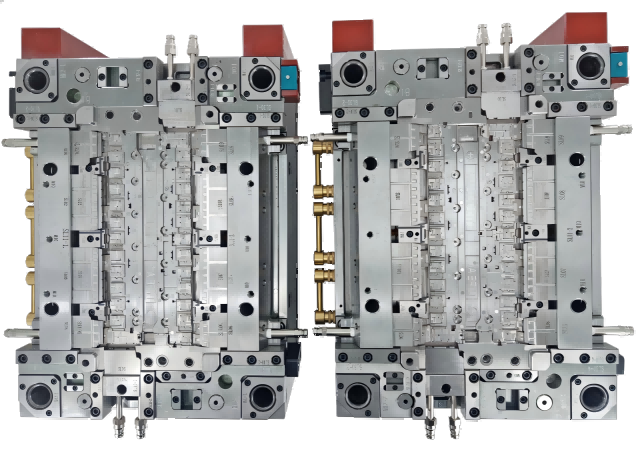
A supplier's production capability affects its ability to manage multiple projects and meet agreed delivery schedules.
Before establishing a long-term relationship, buyers should understand the manufacturer's actual production resources.
Consider asking about:
CNC machining equipment and processing capacity
EDM and wire-cutting capabilities
Mould assembly facilities
Precision measurement equipment
Number of ongoing projects
Outsourced manufacturing processes
Available production scheduling arrangements
It is also useful to understand whether critical machining and assembly operations are completed in-house or outsourced.
This information helps buyers assess production coordination and potential delivery risks.
automotive plastic parts vary significantly in size, structure, material, and functional requirements.
A supplier with relevant automotive mould experience may better understand the challenges associated with different components.
Examples include:
| Component Category | Typical Mould Considerations |
|---|---|
| Dashboard components | Large dimensions, surface appearance, and dimensional stability |
| Door panel parts | Structural geometry, clips, and assembly fit |
| Connector housings | Small features, dimensional accuracy, and repeatability |
| Lighting housings | Complex geometry and surface requirements |
| Air conditioning components | Functional structures and material characteristics |
| Battery enclosures | Structural requirements and dimensional consistency |
Buyers should request relevant project examples and confirm whether the supplier has experience with similar materials, component structures, and mould configurations.
A competitive quotation should be based on clearly defined technical requirements.
Automotive mould costs are influenced by several factors:
Product size and geometric complexity
Mould steel and component materials
Number of cavities
Mould base and structure
Hot runner or cold runner configuration
Required surface finish
Machining precision
Expected mould lifespan
Testing and validation requirements
When comparing quotations, buyers should avoid focusing only on the total price.
A lower quotation may exclude certain services, inspection requirements, mould modifications, or additional components.
For long-term OEM cooperation, it is better to establish a clear quotation scope that defines what is included and how additional changes will be priced.
Automotive product development often follows a fixed schedule. Delays in mould design, machining, assembly, or sample approval can affect downstream production plans.
A good supplier should provide a project schedule and communicate progress at important milestones.
These milestones may include:
Technical review and quotation confirmation
Mould design approval
Mould material preparation
Machining completion
Mould assembly
First trial and sample evaluation
Design adjustments and subsequent trials
Final acceptance and delivery
Buyers should also understand how the supplier handles urgent changes, unexpected manufacturing issues, and schedule adjustments.
Clear communication helps both parties coordinate engineering decisions and production planning.
Automotive moulds may undergo repeated production cycles, so maintenance and technical support remain important after delivery.
A reliable supplier should clarify its support arrangements, including:
Technical assistance after mould delivery
Mould repair and modification services
Replacement of worn mould components
Spare parts availability
Maintenance recommendations
Support for future product revisions
The service scope and response arrangements should be confirmed in the cooperation agreement.
For OEM customers managing multiple moulds, a consistent maintenance process can help improve production planning and reduce unexpected downtime.
Automotive OEM customers may have specific supplier qualification requirements.
Depending on the project, buyers may need to review:
ISO 9001 quality management certification
IATF 16949 certification, where required
Relevant material certificates
Dimensional inspection reports
PPAP documentation, when applicable
Traceability and change management procedures
A certification should be verified for the actual manufacturing entity and its scope. Buyers should not assume that every mould supplier automatically meets automotive production quality requirements.
Before selecting an automotive mould supplier, buyers can use the following questions to evaluate its suitability.
Do you have experience manufacturing similar automotive plastic moulds?
Can your engineering team provide DFM analysis and mould design support?
Which machining and inspection processes are available in-house?
How do you manage mould trials and sample approval?
Can you provide inspection reports and relevant quality documentation?
How are design changes and additional modifications handled?
What technical support is available after mould delivery?
Can you support repeat orders and future product development?
The answers should be supported by actual equipment information, project examples, technical documentation, and clearly defined service commitments.
A good automotive mould supplier for long-term OEM projects should offer more than competitive pricing. Engineering expertise, consistent manufacturing quality, production capacity, delivery coordination, and after-sales support are all important factors.
Before choosing a partner, evaluate its experience with similar automotive components, verify its manufacturing resources, and clarify quality and communication procedures.
A well-established cooperation process can help OEM customers manage mould development more effectively and build a stable foundation for future automotive component projects.
If you are planning an automotive mould project, sharing your 3D drawings, material requirements, and expected production volume is a practical first step toward evaluating a potential manufacturing partner.
We attach great importance to the customers' demands for product quality and rapid production.
We always believe that meeting the customers' needs is the realization of our value!
Copyright © 2026 YouKing Mould Co., Ltd All rights reserved.| Sitemap| Sitemap
Privacy Policy / Cookie Policy / Terms & Conditions